
Chinese New Year traditions
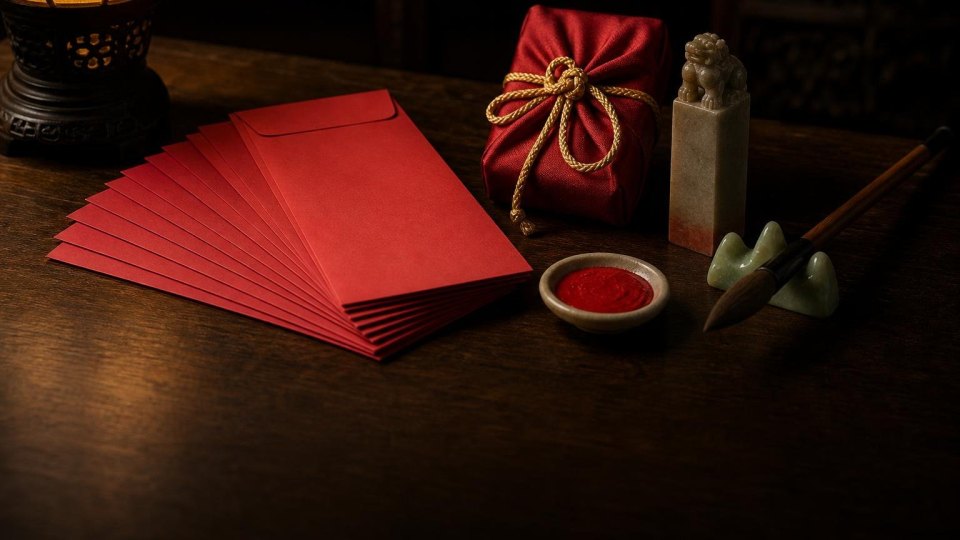
The Spring Festival is a fifteen-day stretch. The new moon opens it; the Lantern Festival closes it. What a family actually does is older than any tourist list: the same gestures return every year, in an order that is easy to miss if one only counts fireworks.
Before the new moon
The week before is sometimes called the little New Year. The kitchen god, who has watched the household all year, is sent to report to the Jade Emperor. Families offer sweets, cakes and wine; some smear honey on his lips so that only sweet words leave his mouth. His picture is burned; he leaves with the smoke. A few days later a new picture goes up in the kitchen: he is back.
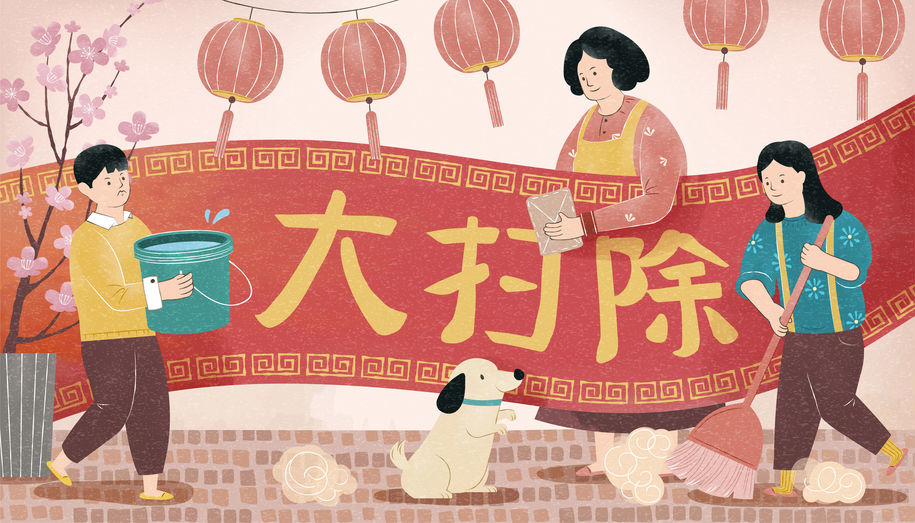
Then the house is cleaned, corners and the backs of furniture included, so that the old year and whatever hid in the dark can leave. Windows are washed or repaired. Some households repaint the courtyard door. New clothes are bought — especially for children. Hair is cut before the festival: a new start. During the first lunar month it is not cut. The old explanation is a curse from 1645, when the Ming faced the Manchu order to shave the head: cut your hair in the first month, and your uncle dies. The first cut of the new cycle waits until Longtaitou, the second day of the second lunar month. Laba porridge, weeks earlier, has already opened the kitchen of the New Year.
When the cleaning is done, red paper goes up. Couplets — chunlian — two strips, one verse on each doorpost, that read as a pair. They used to be written by hand. A fu character is pasted on the door, often upside down. Cut paper in red, on windows and doors, shows luck, wealth and long life. Flowers come in: Japanese apricot for luck, kumquat and narcissus for prosperity, sunflower for a good year, golden lily of the valley for peace. Red is everywhere. Some families still buy gold to welcome the year. The number eight, whose sound is close to prosperity, is used wherever a number is chosen.
The inverted fu
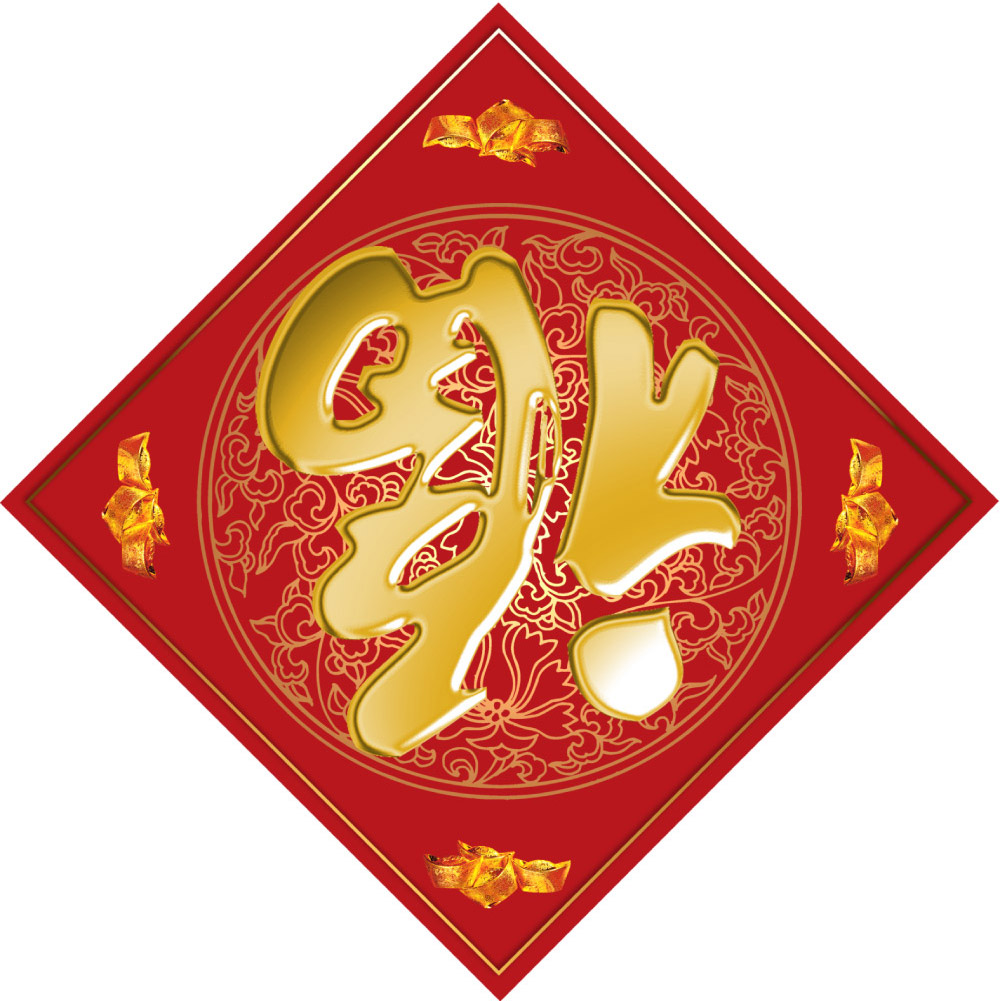
The character 福 (fú) means luck, blessing, happiness. Pasting it on the door at New Year is the ordinary wish for a good year. Hung upside down, it is a pun: 福倒 (fúdǎo, “fu upside down”) sounds like 福到 (fúdào, “fu arrives”). The motif is no longer only a New Year door: it is manufactured on charms and crafts all year.
A Ming story explains the inversion another way. The Hongwu emperor, Zhu Yuanzhang, meant to mark households for killing with the word “fu”. Empress Ma, to avert the massacre, ordered every home in the capital to paste the character on the door before dawn. Illiterate families put it up the wrong way. The emperor, told of one such door, ordered the household seized. The empress said they had hung it inverted on purpose, because they knew he was coming: luck was about to arrive. He let them go. The upside-down fu has remembered that story as well as the pun.
New Year’s Eve
Families stay in. The Chinese word for “year”, nian, is also the name of a beast that, in the legend, prowled villages one night a year; people shut themselves in and sat up until morning, when it left. Sitting up the whole night is still taken as a wish for long life. They snack on watermelon seeds, sweets and dried fruit, play mahjong, and give the red envelopes. Firecrackers, where they are still allowed, drive off what should not enter.
The reunion dinner — nianyefan — is the meal of the year, usually in the house of the elders. Fish is served whole because yú, “fish”, sounds like “surplus”; some families leave some in the dish on purpose, to show there is more than enough. In the north, dumplings shaped like old gold ingots; in the south, niangao, a sticky rice cake, because it rises. In Cantonese country, oysters, because the word also means “good deal”. Longevity noodles, uncut. Oranges and mandarins. Seeds of melon, pumpkin and sunflower for fertility. In many flats the CCTV New Year gala, first broadcast in the 1980s, runs in the background: song, sketch, dance, the same evening for the whole country. There is even a film genre for the season, as Christmas films are a genre in the West: family, comedy, a happy ending, a plot that does not always hold together.
The first days
The first day of the first lunar month is also called the three beginnings: first day, first month, start of the year. At dawn the family honours the ancestors — fruit, New Year cakes, savoury and sweet food, wine, incense, red candles — before the wooden tablets that bear the names of the dead. Then the living greet one another. Children, from eldest to youngest, son then daughter, offer wishes and receive hongbao. Guests may give an orange, for luck and long life. Clementines sit on the household altar and are offered to visitors. This first day is traditionally vegetarian: the body is to be purified. Married daughters do not visit their parents’ house this day, in the old rule: it would bring them bad luck. A woman, in the strictest form of the same rural code, did not leave her own house at all.
The afternoon and the next two days are for visits — relatives, friends, even superiors: the ritual of “being a guest” (zuo ke). Cards go to those too far to see. The second day is the son-in-law’s day: married women take husband and children to her parents. The family also prays to the god of wealth, with incense and firecrackers. After the vegetarian first day, the meal is again the banquet of New Year’s Eve.
The third day, in one tradition, is the wedding of the mice: the household rises without disturbing them and leaves food in the four corners. One legend tells of a charcoal burner who took in a girl, saw claws in the dumpling dough, took her for a witch, and after she vanished offered food to mice once a year to appease her. Another says that if rice is cooked too wet in the first three days, it will rain whenever one goes out that year.
On the fourth day the household gods return; offerings wait for them. Daily work begins to resume. The fifth is the birthday of the god of wealth in Hong Kong; shops reopen. Some households take decorations down. The festival itself is not over.
A Jin-dynasty belief (265–420) assigns the first eight days of the year: chicken, dog, pig, goat, ox, horse, human, grain. The seventh is Renri, the day of mankind. In the old count, everyone ages on that day, not on the birthday: a child born in the twelfth month is already one, and turns two on Renri. Clear weather that day promised many births. The family eats long noodles, sometimes with meat and bamboo shoots — bamboo sounds like “to wish”, and stays green. The eighth is the birthday of the Jade Emperor. The fifteenth, the first full moon, is the Lantern Festival: glutinous rice balls in a sweet soup, yuanxiao in the north, tangyuan in the south, lanterns, riddles, and the last night of the year.
Lion dance
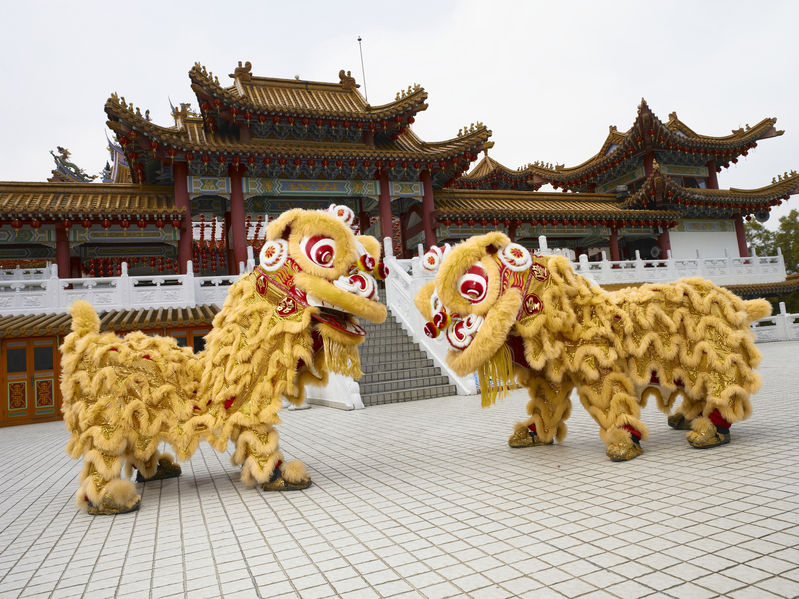
The lion is usually two people under one skin: one holds the head, the other bends and holds his partner’s belt. A child teases it with an embroidered ball; the lion leaps, snaps, scratches, blinks. A cub may follow, one dancer using arms as front legs. There is a hand-worked lion of bamboo hoops, and a “bench lion” whose body is a bench with a head at one end. In Beijing the head is the point, thirty to forty-five kilos, held high; it was a masons’ dance before 1949. Hubei dockers send the lion under five stacked tables and off the top, more than three metres. In the south a gift wrapped in red, with a bunch of greens, hangs from an eight-metre pole; the lion climbs a human ladder and swallows it, drums, gongs and firecrackers around it. The dance is recorded as a stage art from the Southern and Northern dynasties (420–589), and was already highly worked under the Tang (618–907). Since 1949 professionals have taken it from the street onto the stage: lions on wooden balls across a rocking plank, lions on a cable seven metres up.
Families and shops commission the dance. It is supposed to chase bad spirits and bring luck. The dragon, in the parades, is the other public animal: the ultimate sign of good fortune. Firecrackers and fireworks, where they are still allowed, are the same idea in another form — the loudest night of the year, anywhere.
What not to do
These taboos are the rural code, and the guide that lists them says they are mostly forgotten. They still explain gestures that look arbitrary from outside.
On the first day: do not sweep — you would sweep wealth out. Do not go to hospital in the first days, for fear of cursing the year’s health. Do not cry, and try not to make children cry, or you cry all year. Do not break anything in the fifteen days: it is read as a money loss. Settle debts before the year turns. In the south, especially Canton and Hong Kong, do not buy shoes: in Cantonese “shoe” sounds like “to lose”.
The recorded greetings and the gifts, and what not to give, have their own pages. The countdown sits on the first page; the table of the next years on the last.