
Chinese Stroke Order
This tool shows you how to write Chinese characters correctly, stroke by stroke: each stroke is drawn in turn, in the right order and the right direction, and you can then trace them yourself on the model.
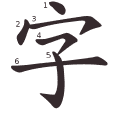
Type a character and its strokes are drawn one by one, in the right order and the right direction. Set the speed, pause the stroke midway, or step through one stroke at a time. Clicking a finished stroke replays that stroke alone.
Stroke order is not a school convention. It is what keeps a character legible when written quickly, and it is how dictionaries file the characters you cannot yet pronounce.
Write it myself turns the tool around: you trace on the grey model, with a finger or the mouse, and each stroke is checked against its reference line — right stroke, right place, right direction. It only turns black when it is correct. 2 262 characters have their strokes, in both simplified and traditional.
Why the order of strokes is fixed
A Chinese character is not drawn, it is written, in a fixed sequence that every schoolchild learns: top before bottom, left before right, horizontal before crossing vertical, the enclosing box before what goes inside it and its closing stroke last. The rules are few and they cover nearly everything.
They are not an arbitrary discipline. Written in the right order, a character comes out balanced almost by itself, because each stroke leaves the brush or pen in the right place for the next. Written in the wrong order, the same strokes drift and the character looks off in a way that is hard to name and easy to see. The order also decides the stroke count, which is how characters are sorted in a traditional dictionary, and it is what makes handwriting recognition work on a phone.
The animation here shows the sequence for any character, stroke by stroke, at the speed you choose. It is worth watching once for every new character, and worth copying by hand at least a few times: writing is what makes you notice the parts a character is built from.