
Origins of Chinese New Year
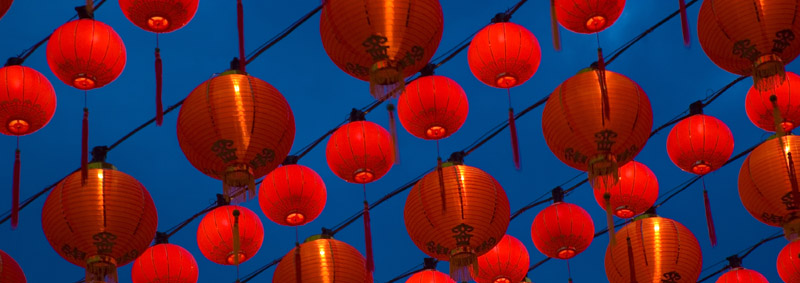
Chunjie, the Spring Festival, is the great traditional feast of the year. Its origin is agricultural. Neolithic farmers already saw the four seasons in the growth of crops; that gave the first idea of nian, the year. The word itself came later. The Erya, among the Thirteen Classics, a glossary of ancient texts from the third century BCE, records older names: zai under Yao and Shun (22nd–21st centuries BCE), sui under the Xia (21st–17th), si under the Shang (17th–11th), and nian from the start of Western Zhou (11th century–256 BCE), with harvest celebrations and sacrifices at the turning of the year.
Under Emperor Wu of Western Han (140–88 BCE) the Taichu calendar fixed the first month of spring — the first moon — as the beginning of the year. That lunar year was kept until the end of Qing (1616–1911). In 1913 the first day of the first lunar month was mandated as the Spring Festival. The Republic (1912–1949), adopting the solar calendar, made Chunjie the official name of the lunar New Year. Since 1949 the People’s Republic has given three days off, now stretched into a Golden Week so that the feast can be spent with family.
The names of the first day
Before Chunjie, the first lunar day had other names. Under Qin (221–206 BCE): Shang Ri, Yuanri, Gaisui, Xiansui — the day one year yields to the next. Under the two Han: Sanchao, Suiri, Zhengdan, Zhengri. Through the Three Kingdoms, Jin, Northern and Southern dynasties and Sui: Yuanchen, Yuanri, Yuanshou, Suishou, Suichao. From Tang to Ming: Yuandan, Suiri, Xinzheng, Xinyuan. Under Qing: Yuandan, Yuanri. The festival still runs to the fifteenth, the Lantern Festival.
Nian
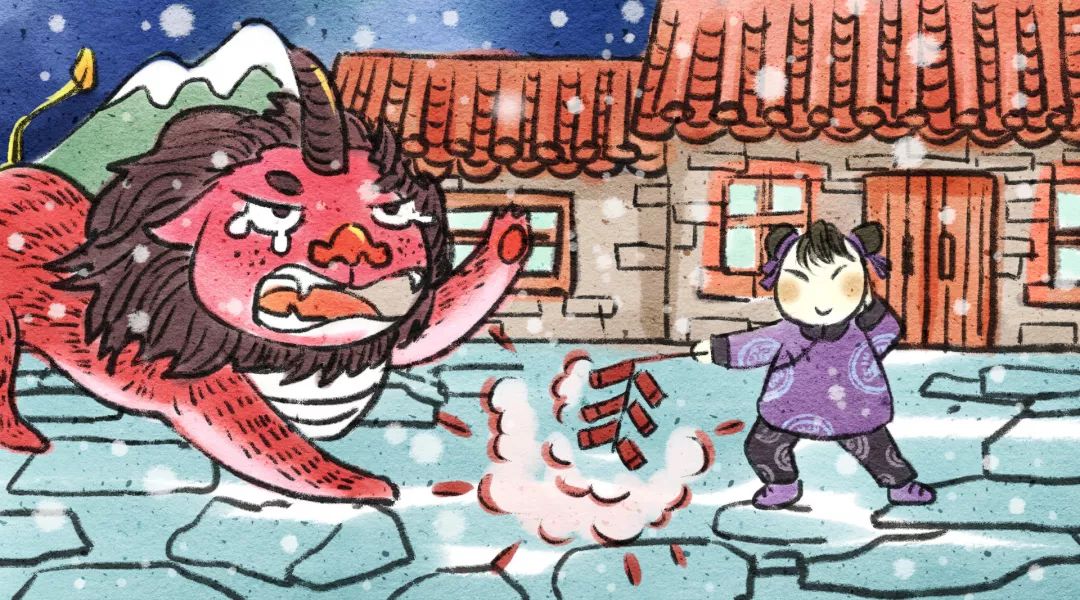
The Spring Festival is also called guonian. Nian, or Nianshou, is an imaginary animal of ill omen. When it comes, trees wither, leaves scatter, grass dies; when it has gone, living things grow and flowers open. The way to send it off is firecrackers — hence the custom.
The legend: a fierce horned beast lived at the bottom of the sea and came ashore on New Year’s Eve to eat livestock and people. Villagers took the old and the children into the mountains. One Eve, an old beggar with a white beard arrived in the village of Taohua. A woman from the east of the village urged him to flee. He laughed: if she let him stay the night, he would drive the beast off. At midnight Nian entered, saw red paper on her door and a house full of light, and sprang. In the courtyard, bangs — bamboo bursting. The beast fled. Nian fears red, flame and noise. In the morning the villagers found the red papers, the still-cracking bamboo, the candles. They changed clothes, congratulated one another, and the neighbouring villages learned the method. Ever since, on New Year’s Eve, families paste red couplets, set off crackers, keep candles and sit up until sunrise; in the morning they go to wish the year.
The widow Wang and the dragon
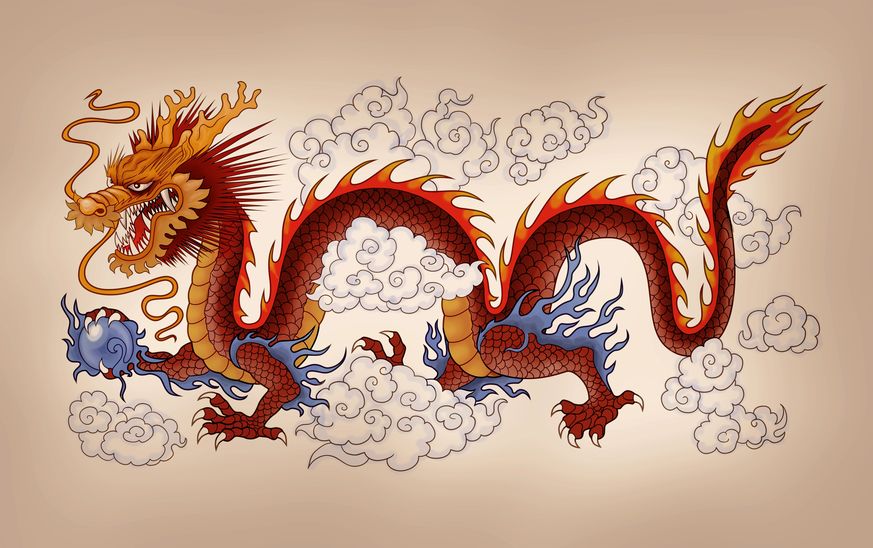
A longer tale, told for children, sits beside Nian. In a fishing village no one kept lunar New Year: a man had killed a sea dragon, and each year at dawn the dragon’s ghost came demanding a newborn son, or it would ruin the harvest and the village. Year after year a different family gave a boy. When it was the turn of the widow Wang and her only child, five years old, her husband already lost at sea, she would not lament. She cut her own hand, soaked a cloth, hung it around the door, stacked bamboo in the yard, and at the ghost’s approach lit it. Blood and the bursting canes sent the dragon running. At dawn the village drums, bells, gongs and crackers answered. Since then, the story says, doors are wrapped in red paper and crackers are let off at first light, and the ghost has not come back.
The two legends do not tell the same beast. They tell the same practice: red on the door, noise at dawn, a night spent awake.
Lunar New Year across Asia
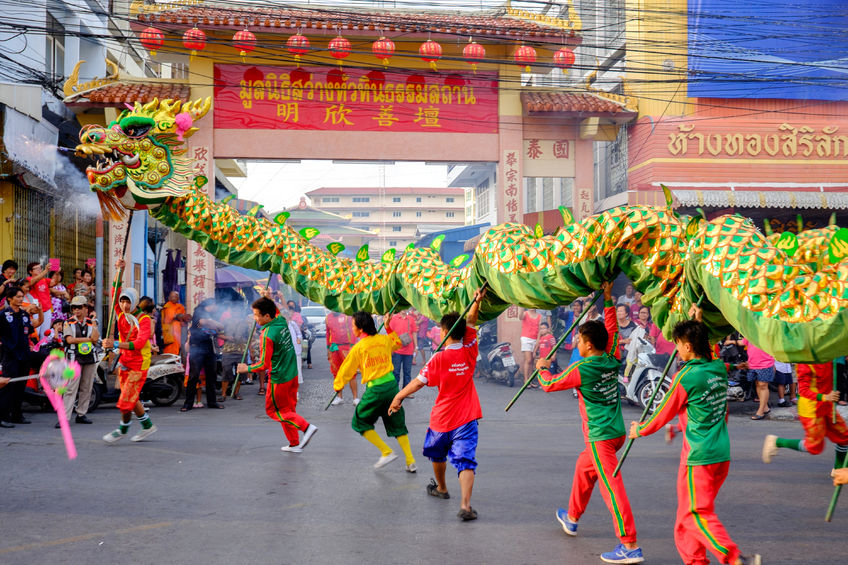
For a large part of Asia, in the country or abroad, the lunar New Year is the feast of the year. It is also called Asian New Year, and Tet in Vietnam, where the course of the days is close to China’s. In Korea the first day is Seollal: families gather, eat tteokguk, give New Year money, and greet the elders. In Malaysia and Singapore, New Year’s Eve is often a half-day off; the celebrations there are among the largest in the region. In the Philippines it is the main Filipino-Chinese festival, a public holiday since 2012. In Indonesia, Baru Imlek, kept by Chinese Indonesians since 1999, a public holiday since 2003, with parades and fireworks in Jakarta, Medan, Singkawang and other cities with Chinese populations. Thailand and Singapore keep it too. The oldest Chinese New Year parade outside Asia is named for California, in the 1860s.
The fifteen days describe what a household does with that inheritance. The countdown is for the year that is coming.