
Measure word
Stroke order
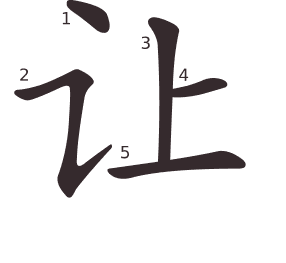
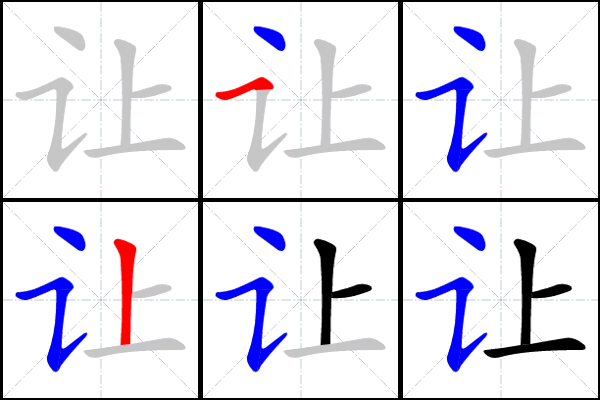 Show the animation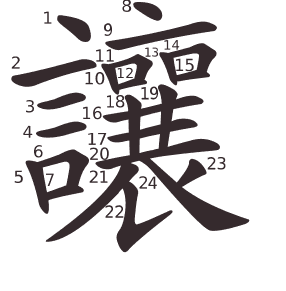
Stroke data from Make Me a Hanzi, derived from the Arphic PL fonts under the Arphic Public License.
How it used to be written
These are the forms of 讓, the traditional character: 让 is a twentieth-century simplification, found in no ancient corpus.
-
 Warring States script 戰國.晉
 -
 Clerical script 東漢
 - See all 8 forms
Forms, sources and dates: the 字形演變 database of 小學堂, Academia Sinica, public domain (CC0).
Examples
-
911事件让世人震惊,全球所有的政治家都一致谴责恐怖分子的这一应受人斥责的行径。
Shocked by the events of September 11th, politicians all over the world condemned the terrorists of their reprehensible deed.
-
Ronnie James Dio的死让我非常难过。
The death of Ronnie James Dio made me very sad.
-
不要做任何会让你后悔的事。
Don't do anything you'll regret.
-
不要再让这种事发生了!
Don't let that happen again!
-
不要让他碰它。
Don't let him touch it.
-
与其让我在他手下干,我宁愿辞职。
I would rather quit than work under him.
-
丑闻让他付出了失去声誉的代价。
That scandal cost him his reputation.
-
世界上的教育都让我失望。
Education in this world disappoints me.