
给 給
给給 in English
- to / for / for the benefit of / to give / to allow / to do sth (for sb) / (grammatical equivalent of 被) / (grammatical equivalent of 把) / (sentence intensifier)
Measure word
- 个 gè (classifier used before a noun that has no specific classifier); (bound form) individual attested in use
- 件 jiàn item; component; classifier for events, things, clothes etc attested in use
- 份 fèn classifier for gifts, newspaper, magazine, papers, reports, contracts etc; variant of 分[fen4] attested in use
- 点 diǎn point; dot; drop; speck; o'clock; point (in space or time); to draw a dot; to check on a list; to choose; to order... attested in use
Stroke order
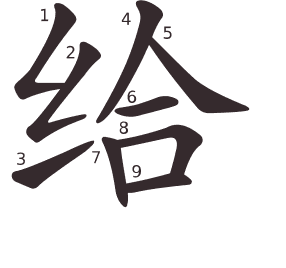
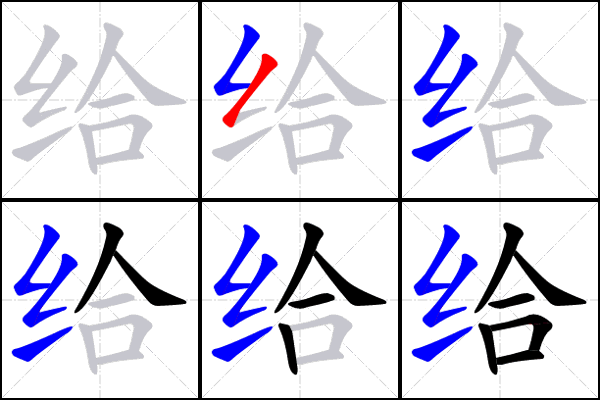 Show the animation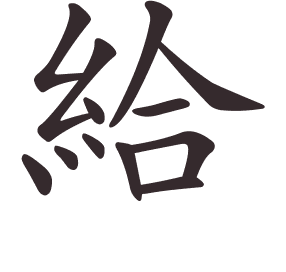
Stroke data from Make Me a Hanzi, derived from the Arphic PL fonts under the Arphic Public License.
How it used to be written
These are the forms of 給, the traditional character: 给 is a twentieth-century simplification, found in no ancient corpus.
-
 Small seal script
 -
 Clerical script 東漢
 - See all 6 forms
Forms, sources and dates: the 字形演變 database of 小學堂, Academia Sinica, public domain (CC0).
Examples
-
我回来就解释给你听怎么用。
I'll explain to you how to use it when I come back.
-
“请把盐递给我。”“拿着。”
"Pass me the salt, please." "Here you are."
-
23点我打电话给她的时候,她已经去睡觉了。
She had already gone to bed when I phoned her at 11:00 p.m.
-
Trang,如果我能寄给你一个棉花糖,我会这么做的。
If I could send you a marshmallow, Trang, I would.
-
一些同学看到我给他巧克力了。
Some classmates saw me give him chocolate.
-
一领到工资就把钱还给你。
I'll pay you back once I receive my salary.
-
七点钟我打电话给你.
I'll call you at seven.