
Stroke order
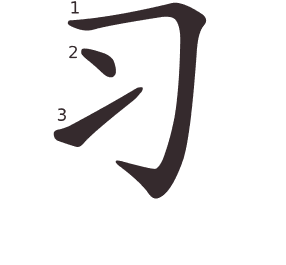
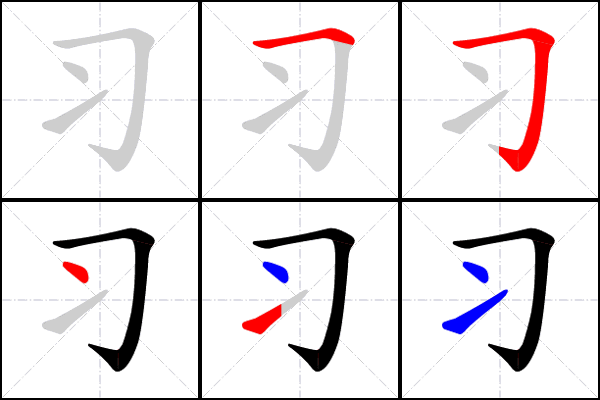 Show the animation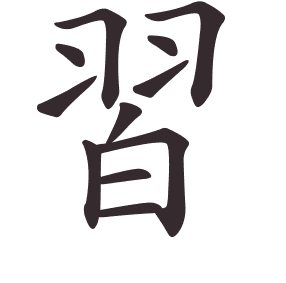
Stroke data from Make Me a Hanzi, derived from the Arphic PL fonts under the Arphic Public License.
How it used to be written
These are the forms of 習, the traditional character: 习 is a twentieth-century simplification, found in no ancient corpus.
-
 Oracle bone script 商
 -
 Clerical script 東漢
 - See all 10 forms
Forms, sources and dates: the 字形演變 database of 小學堂, Academia Sinica, public domain (CC0).
Examples
-
一个国家的风俗习惯反映了它的文化。
The manners and customs of a country reflect its culture.
-
一开始许多事情看上去不同了,但我很快习惯了我的新生活。
At first many things seemed different, but I soon got involved in my new life.
-
一旦养成了坏习惯,就很难改回来了。
A bad habit, once formed, is difficult to get rid of.
-
为了提高我的汉语水平,我想去中国学习。
I'd like to study in China to improve the level of my Chinese.
-
习惯是第二天性。
Habit is second nature.
-
人的后半生就是由他前半生养成的习惯所构成的,其他什么都没有。
The second half of a man's life is made up of nothing but the habits he has acquired during the first half.
-
他专心于学习。
He concentrated on his studies.
-
他也学习汉语。
He studies Chinese as well.