
HSK Chinese Flashcards
To assist you when learning Chinese, review these Flashcards of the Chinese characters of the different levels of HSK. Simply select your HSK level and a card will randomly appear.
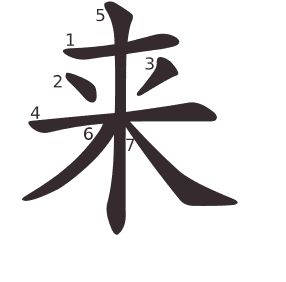
- lái to come; (used as a substitute for a more specific verb); hither (directional complement for motion toward the speaker, as in 回來|回来[hui2lai5]); ever since (as in 自古以來|自古以来[zi4gu3 yi3lai2]); for the past (amount of time); (prefix) the coming ...; the next ... (as in 來世|来世[lai2shi4]); (between two verbs) in order to; (after a round number) approximately; (used after 得[de2] to indicate possibility, as in 談得來|谈得来[tan2de5lai2], or after 不[bu4] to indicate impossibility, as in 吃不來|吃不来[chi1bu5lai2])
My review deck
Your cards and your progress stay in this browser, with no account and no sign-up. Come back to them: spacing them out is what makes them stick.
0 card(s) to review.
Nothing to review yet. Add cards with the "add to my cards" button.
Card 0 of 0
Session over: 0 card(s) reviewed.
0 card(s) still due — a session serves 20 at a time.
How spaced repetition works
We forget most of what we have just learnt within a month. But every time a word is recalled at the moment it was about to fade, it holds on longer. Spaced repetition does nothing else: it places each review just before you would forget, and pushes the following ones further apart as the word settles in.
Here a card climbs seven steps. You knew it: it moves up one step and comes back later — the next day, then after three days, a week, sixteen days, a month and a half, finally four months. You missed it: it drops back to the first step and returns in the next session. A word you have truly learnt ends up asking almost nothing of you, which is the whole point.
A session serves at most 20 cards; the rest waits for the next one. Three minutes a day beats an hour once a month — it is the spacing that makes things stick, not the sitting.
Cards are added from the vocabulary lists, with the “add to my cards” button. They stay in this browser, and so does your progress: no account, no sign-up, nothing sent to the server — and clearing the site data clears both. My vocabulary list shows them all, with their due dates, and knows how to export them together with their progress.
1. Choose the HSK level between 1 and 6. You can also choose the "ALL" option that groups all six levels.
2. Click on the card to obtain the Chinese character information (stroke order, traditional, radical, definition, ...).
3. You can click again the red button at the bottom right to see the character again.
4. To move to another card, simply click the "next" button.
Why flashcards work, and the one rule that makes them work
Chinese vocabulary is the part of the language that cannot be reasoned out. Grammar can be understood once and applied; a word either comes to you or it does not. That makes it the ideal case for spaced repetition, which is not a study trick but a measured finding: a fact reviewed just as you are about to forget it stays far longer than the same fact reviewed too soon.
The rule that makes it work is the one most people break, and it is uncomfortable: you have to answer before you turn the card. Recognising a character you have just been shown feels like knowing it and is not. The effort of retrieval is what strengthens the memory, so a card you got wrong after a real attempt is worth more than three cards you got right by reading the answer early.
Two things are worth doing alongside. Learn words rather than isolated characters, because a two-syllable word is easier to remember and far more useful than either of its halves. And check the vocabulary lists to see the shape of what is ahead: knowing that a level has a few hundred words rather than a few thousand changes how you plan.