
非常
Measure word
- 个 gè (classifier used before a noun that has no specific classifier); (bound form) individual attested in use
- 位 wèi position; location; place; seat; classifier for people (honorific); classifier for binary bits (e.g. 十六位 16-bit or 2... attested in use
- 本 běn (bound form) root; stem; (bound form) origin; source; (bound form) one's own; this; (bound form) this; the current... attested in use
- 朵 duǒ flower; earlobe; fig. item on both sides; classifier for flowers, clouds etc attested in use
- 段 duàn paragraph; section; segment; stage (of a process); classifier for stories, periods of time, lengths of thread etc attested in use
- 种 zhǒng seed; species; kind; type; classifier for types, kinds, sorts attested in use
Stroke order

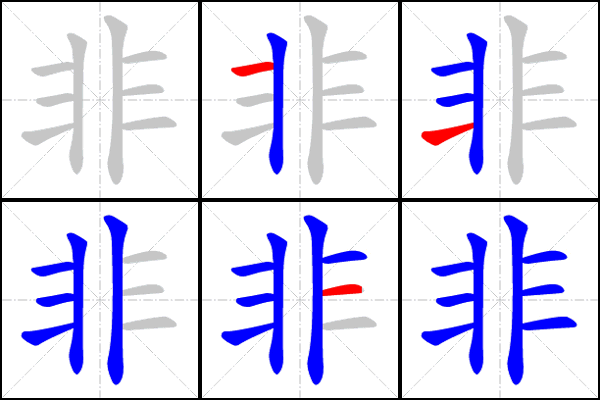 Show the animation
 Stroke data from Make Me a Hanzi, derived from the Arphic PL fonts under the Arphic Public License.
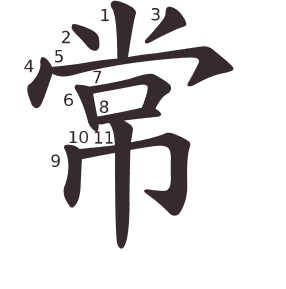
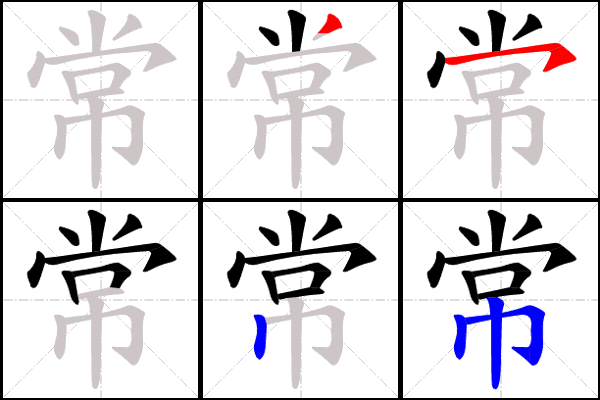 Show the animation
 Stroke data from Make Me a Hanzi, derived from the Arphic PL fonts under the Arphic Public License.
How it used to be written
-
 Oracle bone script 商
 -
 Clerical script 東漢
 - See all 18 forms
Forms, sources and dates: the 字形演變 database of 小學堂, Academia Sinica, public domain (CC0).
Examples
-
Mike非常喜欢动物。
Mike really likes animals.
-
Ronnie James Dio的死让我非常难过。
The death of Ronnie James Dio made me very sad.
-
中国人民非常勤劳。
The Chinese are a hard-working people.
-
乘船过海非常舒服。
It is very pleasant to cross the ocean by ship.
-
今晚我度过了一段非常美好的时光。
I had a really nice time tonight.
-
他们有一个非常漂亮的暖房。
They have a very nice veranda.
-
他们非常兴奋。
They were very excited.
-
他们非常喜欢那首歌曲。
They love that song.