
起来起來 in English
- (after a verb) indicating the beginning and continuation of an action or a state / indicating an upward movement (e.g. after 站[zhan4]) / indicating completion / (after a perception verb, e.g. 看[kan4]) expressing preliminary judgment / also pr. [qi3lai5]
Measure word
- 听 tīng to listen to; to hear; to heed; to obey; a can (loanword from English tin); classifier for canned beverages; to let be... attested in use
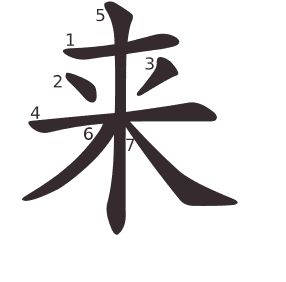
Stroke order

 Show the animation
 Stroke data from Make Me a Hanzi, derived from the Arphic PL fonts under the Arphic Public License.
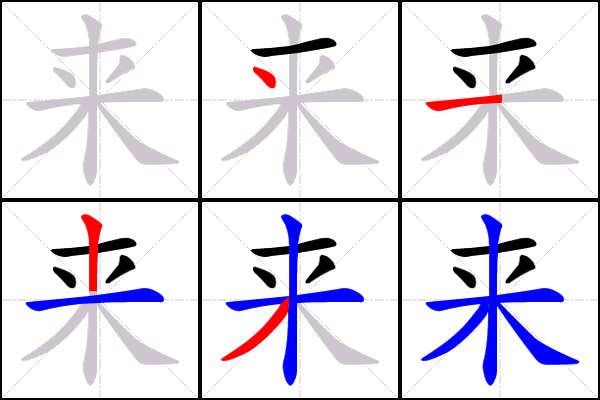 Show the animation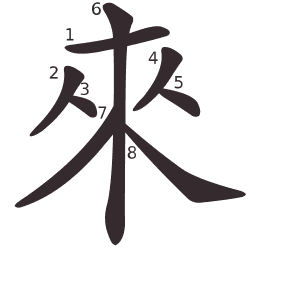
Stroke data from Make Me a Hanzi, derived from the Arphic PL fonts under the Arphic Public License.
How it used to be written
起
-
 Warring States script 戰國.燕
 -
 Clerical script 東漢
 - See all 15 forms
来
These are the forms of 來, the traditional character: 来 is a twentieth-century simplification, found in no ancient corpus.
-
 Oracle bone script 商
 -
 Clerical script 東漢
 - See all 17 forms
Forms, sources and dates: the 字形演變 database of 小學堂, Academia Sinica, public domain (CC0).
Examples
-
一天天热起来了。
It is becoming warmer day by day.
-
三十年前的时装款式又流行起来了。
Fashions of thirty years ago have come back in style.
-
两个孩子的年龄加起来和他们的父亲相当。
The ages of the two children put together was equivalent to that of their father.
-
两个男孩儿吵起来了。
The two boys are quarreling.
-
丹尼尔看起来像个维吾尔族人。
Daniel looks like an Uyghur.
-
从远看得话,这个石头看起来像人的脸。
Seen from a distance, the stone looks like a human face.
-
他不需要那么早起来。
He doesn't need to get up early.
-
他们都哈哈大笑起来。
They all burst out laughing.