
省
省 in English
- to save / to economize / to be frugal / to omit / to delete / to leave out / province / provincial capital / a ministry (of the Japanese government)
- (bound form) to scrutinize / (bound form) to reflect (on one's conduct) / (bound form) to come to realize / (bound form) to pay a visit (to one's parents or elders)
Measure word
- 个 gè (classifier used before a noun that has no specific classifier); (bound form) individual attested in use
Stroke order
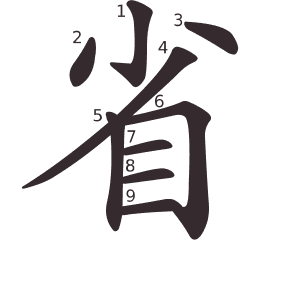
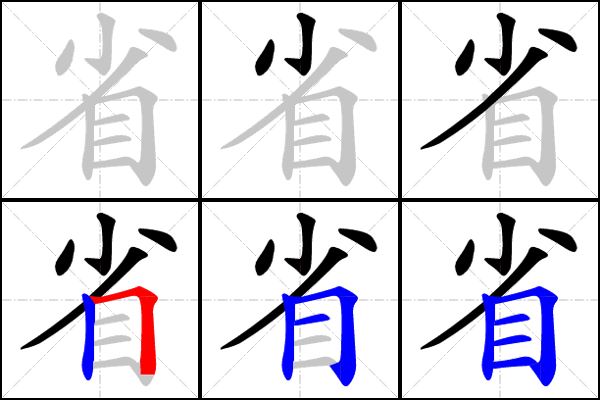 Show the animation
 Stroke data from Make Me a Hanzi, derived from the Arphic PL fonts under the Arphic Public License.
How it used to be written
-
 Oracle bone script 商
 -
 Clerical script 東漢
 - See all 16 forms
Forms, sources and dates: the 字形演變 database of 小學堂, Academia Sinica, public domain (CC0).
Examples
-
他被人发现倒在厨房的地板上,不省人事。
He was discovered unconscious on the floor of the kitchen.
-
台风的破坏跨越了好几个省。
The typhoon caused damage across several provinces.
-
我今天晚点下班,省得明天早上手忙脚乱。
Today I'm working a little late so as to avoid a rush in the morning.
-
浙江省在哪里?
Where is Zhejiang Province?
-
电脑为我们节省了很多时间,解决了很多问题。
Computers save us a lot of time and trouble.
-
省略掉无用的词!
Omit needless words!
-
这辆车很省油。
This car is very economical on gas.
-
道教是用老子的教导创立的,他是公元前六零四年在现代的河南省出生的圣贤。
Taoism was founded on the teachings of Laozi, a sage born in 604 B.C. in present-day Henan Province.