
来 來
来來 in English
- to come / (used as a substitute for a more specific verb) / hither (directional complement for motion toward the speaker, as in 回來|回来[hui2lai5]) / ever since (as in 自古以來|自古以来[zi4gu3 yi3lai2]) / for the past (amount of time) / (prefix) the coming ... / the next ... (as in 來世|来世[lai2shi4]) / (between two verbs) in order to / (after a round number) approximately / (used after 得[de2] to indicate possibility, as in 談得來|谈得来[tan2de5lai2], or after 不[bu4] to indicate impossibility, as in 吃不來|吃不来[chi1bu5lai2])
Measure word
- 点 diǎn point; dot; drop; speck; o'clock; point (in space or time); to draw a dot; to check on a list; to choose; to order... attested in use
- 个 gè (classifier used before a noun that has no specific classifier); (bound form) individual attested in use
- 出 chū to go out; to come out; to arise; to occur; to produce; to yield; to go beyond; to exceed; (used after a verb to... attested in use
- 次 cì next in sequence; second; the second (day, time etc); secondary; vice-; sub-; infra-; inferior quality; substandard... attested in use
Stroke order
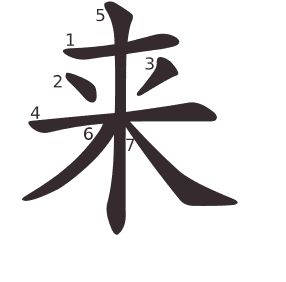
 Show the animation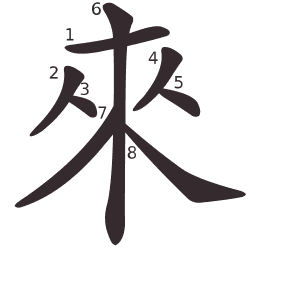
Stroke data from Make Me a Hanzi, derived from the Arphic PL fonts under the Arphic Public License.
How it used to be written
These are the forms of 來, the traditional character: 来 is a twentieth-century simplification, found in no ancient corpus.
-
 Oracle bone script 商
 -
 Clerical script 東漢
 - See all 17 forms
Forms, sources and dates: the 字形演變 database of 小學堂, Academia Sinica, public domain (CC0).
Examples
-
我回来就解释给你听怎么用。
I'll explain to you how to use it when I come back.
-
“为什么你不来?”“因为我不想。”
"Why aren't you going?" "Because I don't want to."
-
“你什么时候回来?”“这都要看天气。”
"When will you come back?" "It all depends on the weather."
-
“电话响了。”“我来接。”
"The phone is ringing." "I'll get it."
-
「你们俩怎么认识的呀?」「说来话长。」
"How did you two meet?" "It's a long story."