
悲伤 悲傷
Measure word
Stroke order
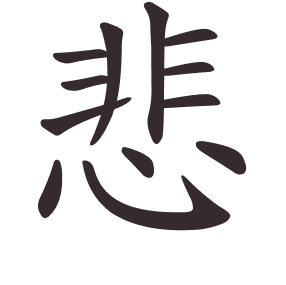
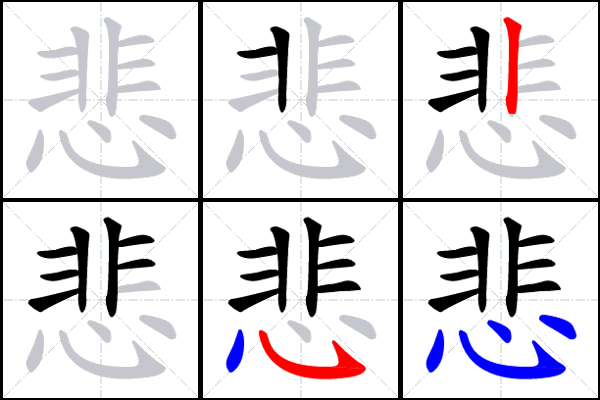 Show the animation
 Stroke data from Make Me a Hanzi, derived from the Arphic PL fonts under the Arphic Public License.

 Show the animation
Stroke data from Make Me a Hanzi, derived from the Arphic PL fonts under the Arphic Public License.
How it used to be written
悲
-
 Chu manuscripts 戰國.楚
 -
 Clerical script 東漢
 - See all 10 forms
伤
These are the forms of 傷, the traditional character: 伤 is a twentieth-century simplification, found in no ancient corpus.
-
 Warring States script 戰國.燕
 -
 Clerical script 東漢
 - See all 12 forms
Forms, sources and dates: the 字形演變 database of 小學堂, Academia Sinica, public domain (CC0).
Examples
-
听到这个悲伤的消息,她泣不成声。
Hearing the sad news, she collapsed in tears.
-
她的眼神里充满了悲伤。
Her eyes were full of sadness.
-
我不喜欢悲伤的电影。
I don't like sad movies.
-
没有你我很悲伤。
I'm sad without you.
-
消息给他带来了深深的悲伤。
The news made him feel deeply sad.