
动動 in English
- (of sth) to move / to set in movement / to displace / to touch / to make use of / to stir (emotions) / to alter / abbr. for 動詞|动词[dong4 ci2], verb
Stroke order
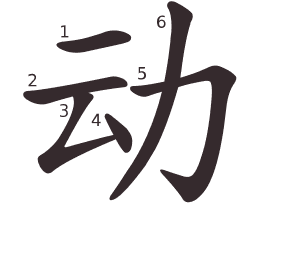
 Show the animation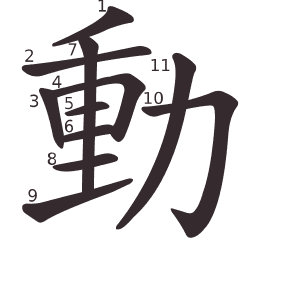
Stroke data from Make Me a Hanzi, derived from the Arphic PL fonts under the Arphic Public License.
How it used to be written
These are the forms of 動, the traditional character: 动 is a twentieth-century simplification, found in no ancient corpus.
-
 Bronze script 西周晚期
 -
 Clerical script 東漢
 - See all 12 forms
Forms, sources and dates: the 字形演變 database of 小學堂, Academia Sinica, public domain (CC0).
Examples
-
Jane 又胖、又没礼貌、又烟不离手,可是 Ken 却觉得她可爱、动人,所谓「爱情是盲目的」,大概就是这个意思了吧。
Jane is fat and rude, and smokes too much. However, Ken thinks she's lovely and charming. That's why they say love is blind.
-
Jane在运动会之前把头发剃短了。
Jane had her hair cut short before the athletic meeting.
-
John启动了车。
John started the car.
-
Mike非常喜欢动物。
Mike really likes animals.
-
一个完完全全的不及物动词既没有补语,又没有宾语。
A complete intransitive verb takes neither complement nor object.
-
上星期天我的家庭去了动物园看熊猫。
My family went to the zoo to see pandas last Sunday.
-
不要动。
Don't move.
-
不要虐待动物。
Don't be cruel to animals.