
出来出來 in English
- (after a verb, indicates coming out, completion of an action, or ability to discern or detect)
Stroke order
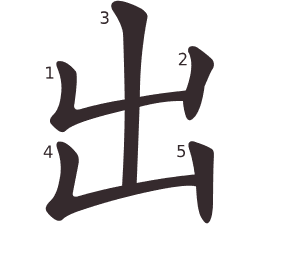
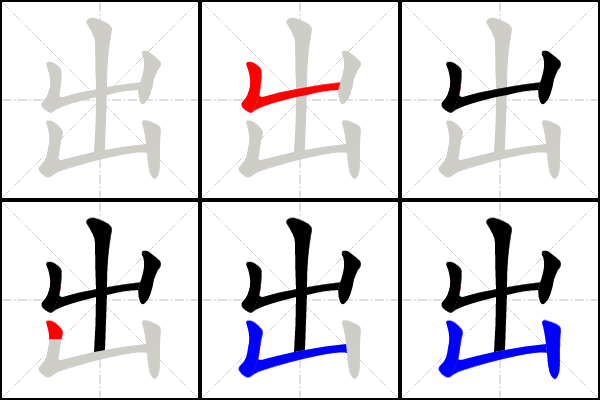 Show the animation
 Stroke data from Make Me a Hanzi, derived from the Arphic PL fonts under the Arphic Public License.
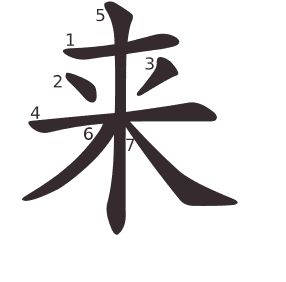
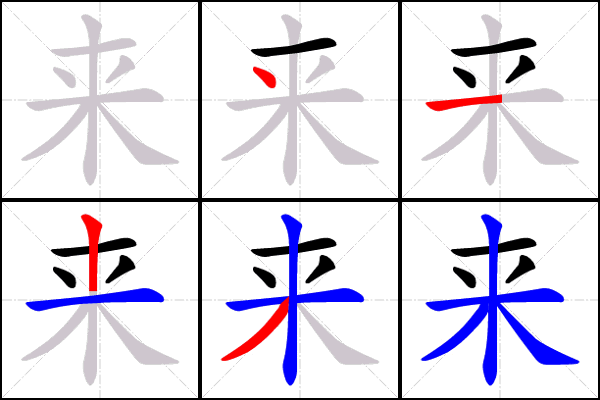 Show the animation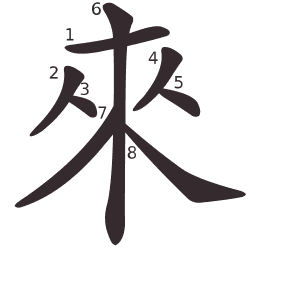
Stroke data from Make Me a Hanzi, derived from the Arphic PL fonts under the Arphic Public License.
How it used to be written
出
-
 Oracle bone script 商
 -
 Clerical script 東漢
 - See all 19 forms
来
These are the forms of 來, the traditional character: 来 is a twentieth-century simplification, found in no ancient corpus.
-
 Oracle bone script 商
 -
 Clerical script 東漢
 - See all 17 forms
Forms, sources and dates: the 字形演變 database of 小學堂, Academia Sinica, public domain (CC0).
Examples
-
从根部把植物拔出来。
Pull the plant up by the roots.
-
他们用慢动作把那一幕播了出来。
They showed the scene in slow motion.
-
他在撒谎,我每次都看得出来。
He's lying, I can always tell.
-
但是说真的,第21集让我笑得眼泪都要出来了。
Seriously though, episode 21 made me almost cry while laughing.
-
你想把耳朵露出来吗?
Would you like your ears to show?
-
你把衣服从洗衣机里拿出来了吗?
Did you take the clothes out of the washing machine?
-
你该把事实说出来。
You should tell the truth.
-
别让我笑出来。
Don't make me laugh.