
你
你 in English
- you (Note: In Taiwan, 妳 is used to address females, but in mainland China, it is not commonly used. Instead, 你 is used to address both males and females.)
Measure word
- 个 gè (classifier used before a noun that has no specific classifier); (bound form) individual attested in use
- 点 diǎn point; dot; drop; speck; o'clock; point (in space or time); to draw a dot; to check on a list; to choose; to order... attested in use
- 遍 biàn everywhere; all over; classifier for actions: one time attested in use
Stroke order
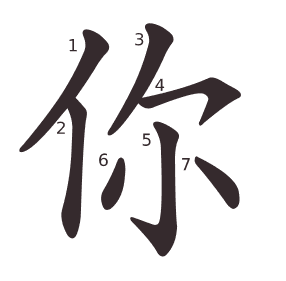
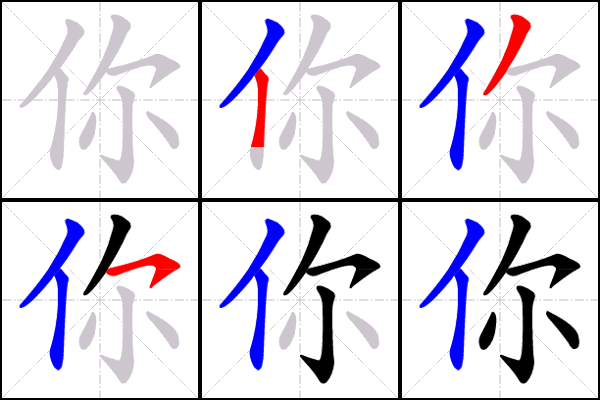 Show the animation
 Stroke data from Make Me a Hanzi, derived from the Arphic PL fonts under the Arphic Public License.
Examples
-
我回来就解释给你听怎么用。
I'll explain to you how to use it when I come back.
-
"你为什么不去?""因为我不想去。"
"Why aren't you going?" "Because I don't want to."
-
“上周你看电视了吗?”“没有,我没看。”
"Did you watch TV last week?" "No, I didn't."
-
“为什么你不来?”“因为我不想。”
"Why aren't you going?" "Because I don't want to."
-
“你什么时候回来?”“这都要看天气。”
"When will you come back?" "It all depends on the weather."
-
“你去哪儿了?”“我去了火车站送我的一个朋友。”
"Where have you been?" "I have been to the station to see a friend off."
-
“你喜欢蛇吗?”“当然不喜欢。”
"Do you like snakes?" "Of course not."
-
“你太好了。”Willie回答道。
"That's very nice of you," Willie answered.