
输輸 in English
- to lose / to be beaten / (bound form) to transport / (literary) to donate / to contribute / (coll.) to enter (a password)
Stroke order
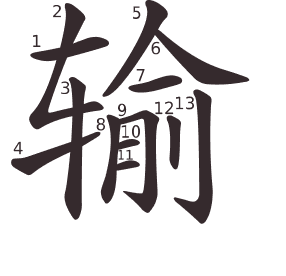
 Show the animation
Stroke data from Make Me a Hanzi, derived from the Arphic PL fonts under the Arphic Public License.
How it used to be written
These are the forms of 輸, the traditional character: 输 is a twentieth-century simplification, found in no ancient corpus.
-
 Small seal script
 -
 Clerical script 東漢
 - See all 8 forms
Forms, sources and dates: the 字形演變 database of 小學堂, Academia Sinica, public domain (CC0).
Examples
-
Ziri要输了。
Ziri will lose.
-
如果我用简体中文输入“什么”,我希望找到的结果里也有“甚麼”。
If I search for "什么" using Simplified Chinese, I expect to also see "甚麼" in the results.
-
我不会输!
I won't lose!
-
我从没输给过汤姆。
I've never lost to Tom.
-
我们玩过了。我们输了。咱们从新来过吧?
We played. We lost. How about starting it over?
-
我用100美元跟我的朋友赌他不会吃活蟑螂。我输了!
I bet my friend $100 that he wouldn't eat a live cockroach. I lost!
-
父母试图将诚实和工作的重要性灌输给孩子。
Parents try to impress upon their children the importance of honesty and hard work.
-
自己赢不重要,重要的是对手要输。
The important thing is not to win, but that the other loses.