
Measure word
Stroke order
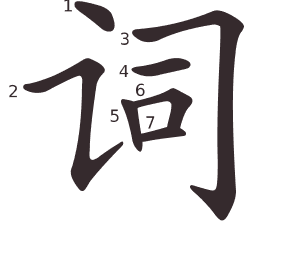
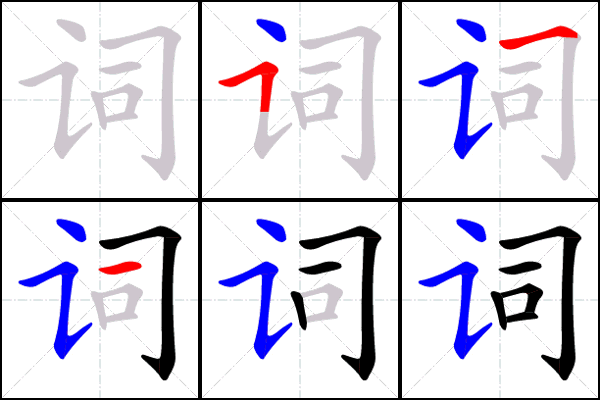 Show the animation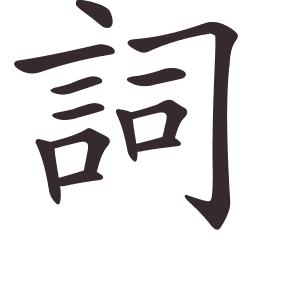
Stroke data from Make Me a Hanzi, derived from the Arphic PL fonts under the Arphic Public License.
How it used to be written
These are the forms of 詞, the traditional character: 词 is a twentieth-century simplification, found in no ancient corpus.
-
 Bronze script 戰國早期.齊
 -
 Clerical script 東漢
 - See all 6 forms
Forms, sources and dates: the 字形演變 database of 小學堂, Academia Sinica, public domain (CC0).
Examples
-
“啊!”是一个感叹词。
"Ah!" is an interjection.
-
「克里奥帕特拉」这个名字已经成为了美女的代名词。
The name "Cleopatra" has become a byword for a beautiful woman.
-
Tatoeba不是词典。
Tatoeba isn't a dictionary.
-
一个完完全全的不及物动词既没有补语,又没有宾语。
A complete intransitive verb takes neither complement nor object.
-
三月小姐给了我一本英语词典。
Miss March gave me an English dictionary.
-
为什么你买了一本那么贵的词典?
Why did you get such a costly dictionary?
-
书桌上的词典是我的。
The dictionary on the desk is mine.
-
他说的词典图书馆没有.
The dictionary he talked about isn't available in the library.