
老
老 in English
- prefix used before the surname of a person or a numeral indicating the order of birth of the children in a family or to indicate affection or familiarity / old (of people) / venerable (person) / experienced / of long standing / always / all the time / of the past / very / outdated / (of meat etc) tough / unicode compatibility variant of 老
Measure word
- 个 gè (classifier used before a noun that has no specific classifier); (bound form) individual attested in use
- 位 wèi position; location; place; seat; classifier for people (honorific); classifier for binary bits (e.g. 十六位 16-bit or 2... attested in use
- 座 zuò seat; base; stand; (bound form) constellation; (archaic) suffix used in a respectful form of address (e.g... attested in use
Stroke order
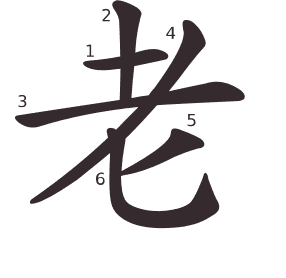
 Show the animation
 Stroke data from Make Me a Hanzi, derived from the Arphic PL fonts under the Arphic Public License.
How it used to be written
-
 Oracle bone script 商
 -
 Clerical script 西晉
 - See all 22 forms
Forms, sources and dates: the 字形演變 database of 小學堂, Academia Sinica, public domain (CC0).
Examples
-
“一只猫?”老先生问。
"A cat?" asked the old man.
-
“好人不长命”是句或真或假的老话。
"The good die young" is an old saying which may or may not be true.
-
John不知道怎么跟他老婆解释他辞了职。
John did not know how to explain to his wife that he had quit his job.
-
上课时她是我们的老师,下课以后是我们的朋友,而且是很好的朋友。
In class she's our teacher; after class she's our friend, and a good friend too.
-
下周我们要去看望我们的老师。
We will visit our teacher next week.
-
不仅他们,连我也被老师罚了。
Not only they but also I was scolded by the teacher.
-
不是每个人都是老实的。
Not everyone is honest.