
Stroke order
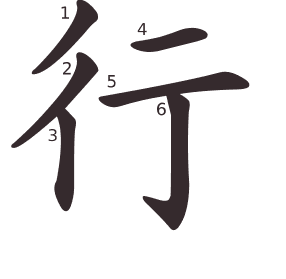
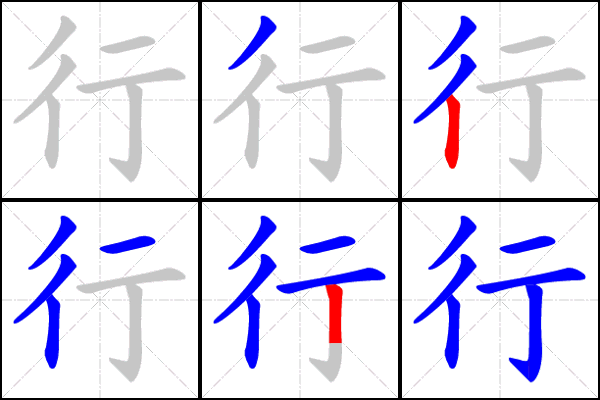 Show the animation
 Stroke data from Make Me a Hanzi, derived from the Arphic PL fonts under the Arphic Public License.

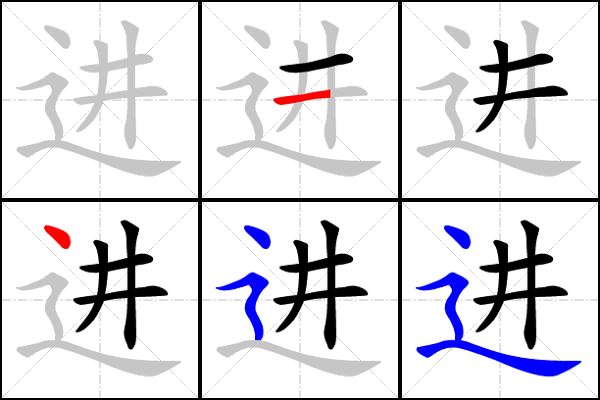 Show the animation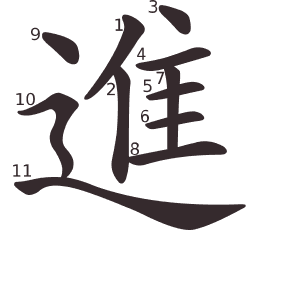
Stroke data from Make Me a Hanzi, derived from the Arphic PL fonts under the Arphic Public License.
How it used to be written
行
-
 Oracle bone script 商
 -
 Clerical script 東漢
 - See all 20 forms
进
These are the forms of 進, the traditional character: 进 is a twentieth-century simplification, found in no ancient corpus.
-
 Oracle bone script 商
 -
 Clerical script 東漢
 - See all 18 forms
Forms, sources and dates: the 字形演變 database of 小學堂, Academia Sinica, public domain (CC0).
Examples
-
一支大军正浩浩荡荡地行进着。
A large army is proudly proceeding.
-
我们在枪林弹雨之下行进。
We marched under a hail of bullets.
-
獾行进时步伐稳定,身体压得很低、贴近地面;旱獭则尤其在兴奋时会疾奔,身体呈波浪状起伏摆动。
The badger travels steadily, with its body very low and close to the ground; the marmot, especially when excited, gallops along, with undulatory movements of the body.
-
箭头表示行进方向。
The arrow indicates the way to go.