
Stroke order
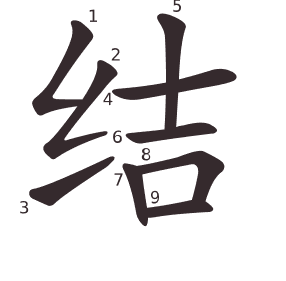
 Show the animation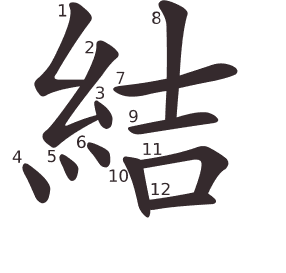
Stroke data from Make Me a Hanzi, derived from the Arphic PL fonts under the Arphic Public License.
How it used to be written
These are the forms of 結, the traditional character: 结 is a twentieth-century simplification, found in no ancient corpus.
-
 Warring States script 戰國.齊
 -
 Clerical script 東漢
 - See all 11 forms
Forms, sources and dates: the 字形演變 database of 小學堂, Academia Sinica, public domain (CC0).
Examples
-
“汤姆,我得告诉你点事。我爱某个人。他的名字以T开头以M结尾。”“呃,那能是谁?我认识吗?
"Tom, I have to tell you something. I love someone. His name starts with T and ends with M." "Er, who would that be? Is it someone I know?"
-
Tom想和Marie结婚。
Tom wants to marry Marie.
-
一时失言常常会带来意想不到的结果。
A slip of the tongue often brings about unexpected results.
-
下周可能会结冰。
It may freeze next week.
-
不管结果如何,他想要做。
He wanted to do it, whatever the consequences.
-
事情真的已经了结了吗?
Is it really all over?
-
人们或可选择何时开始恋爱,但它的终结却不由人。
People can begin to love when they choose, but they have no choice when it comes to ending love.
-
他们分房睡,即使他们已经结婚了。
They sleep in separate bedrooms even though they're married.