
得 in English
- to obtain / to get / to gain / to catch (a disease) / proper / suitable / proud / contented / to allow / to permit / ready / finished
- structural particle: used after a verb (or adjective as main verb), linking it to following phrase indicating effect, degree, possibility etc
- to have to / must / ought to / to need to
Stroke order
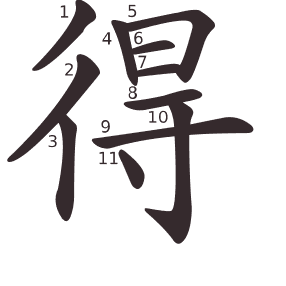
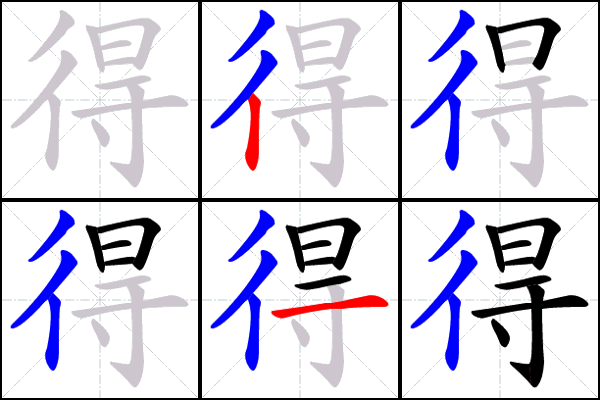 Show the animation
 Stroke data from Make Me a Hanzi, derived from the Arphic PL fonts under the Arphic Public License.
How it used to be written
-
 Oracle bone script 商
 -
 Clerical script 東漢
 - See all 29 forms
Forms, sources and dates: the 字形演變 database of 小學堂, Academia Sinica, public domain (CC0).
Examples
-
“你说得不对” “那怎么说呢?”
"What you said is wrong." "Then what should I say?"
-
“你说得太多了,”他说道。
"You talk too much," he said.
-
“汤姆,我得告诉你点事。我爱某个人。他的名字以T开头以M结尾。”“呃,那能是谁?我认识吗?
"Tom, I have to tell you something. I love someone. His name starts with T and ends with M." "Er, who would that be? Is it someone I know?"
-
「我得买点新衣服了,」狄马想。
"I really need some new clothes," thought Dima.
-
Bill跑得比Bob快。
Bill runs faster than Bob.
-
Emi 是三个女孩中跳得最漂亮的。
Emi danced the most beautifully of the three girls.
-
Jane 又胖、又没礼貌、又烟不离手,可是 Ken 却觉得她可爱、动人,所谓「爱情是盲目的」,大概就是这个意思了吧。
Jane is fat and rude, and smokes too much. However, Ken thinks she's lovely and charming. That's why they say love is blind.
-
Jim 和 Ron 跑得一样快。
Jim runs as fast as Ron.