
Stroke order
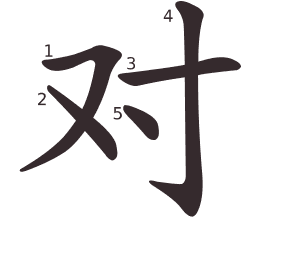
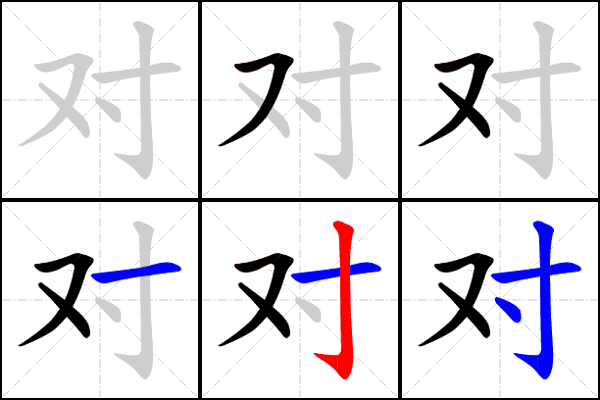 Show the animation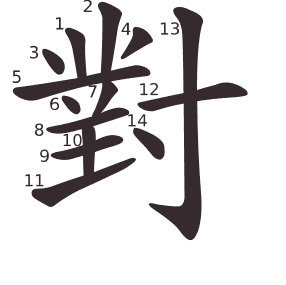
Stroke data from Make Me a Hanzi, derived from the Arphic PL fonts under the Arphic Public License.
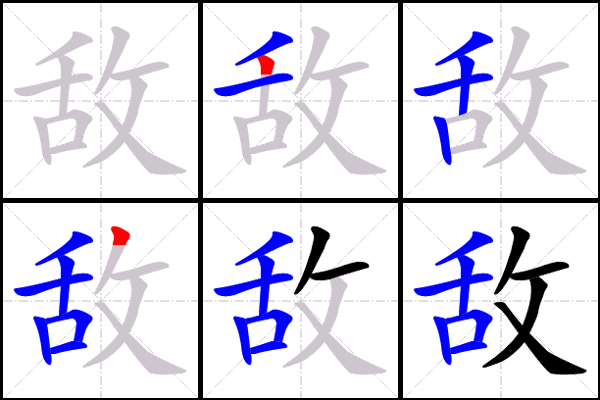 Show the animation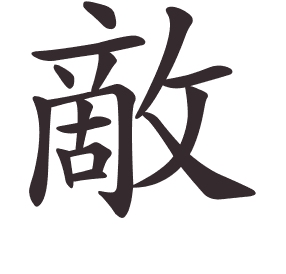
Stroke data from Make Me a Hanzi, derived from the Arphic PL fonts under the Arphic Public License.
How it used to be written
对
These are the forms of 對, the traditional character: 对 is a twentieth-century simplification, found in no ancient corpus.
-
 Oracle bone script 商
 -
 Clerical script 東漢
 - See all 15 forms
敌
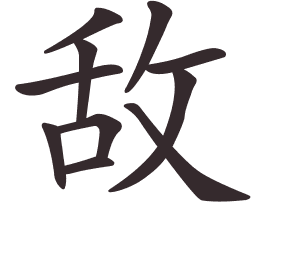
These are the forms of 敵, the traditional character: 敌 is a twentieth-century simplification, found in no ancient corpus.
-
 Bronze script 西周中期
 -
 Clerical script 曹魏
 - See all 7 forms
Forms, sources and dates: the 字形演變 database of 小學堂, Academia Sinica, public domain (CC0).
Examples
-
两军对敌,能战的当战,不能战的当守,不能守的当走,不能走的当降,不能降的当死。
When two armies oppose one another, those who can fight should fight, those who can't fight should guard, those who can't guard should flee, those who can't flee should surrender, and those who can't surrender should die.
-
他后悔对敌人出卖了他的国家。
He repented having betrayed his country to the enemy.