
他
他 in English
- (third-person singular) (since the early 20th century, usu. male) he / him / his / (bound form) other / another / some other (as in 他日[ta1ri4] and 他人[ta1ren2])
Measure word
- 个 gè (classifier used before a noun that has no specific classifier); (bound form) individual attested in use
- 次 cì next in sequence; second; the second (day, time etc); secondary; vice-; sub-; infra-; inferior quality; substandard... attested in use
- 件 jiàn item; component; classifier for events, things, clothes etc attested in use
Stroke order
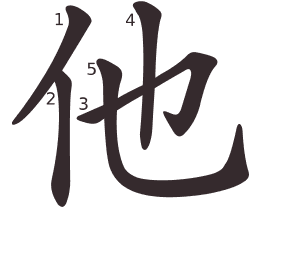
 Show the animation
 Stroke data from Make Me a Hanzi, derived from the Arphic PL fonts under the Arphic Public License.
How it used to be written
-
 Clerical script 西漢
 -
 Clerical script 東漢
 - See all 4 forms
Forms, sources and dates: the 字形演變 database of 小學堂, Academia Sinica, public domain (CC0).
Examples
-
"下次。"他说道。
"Next time," he said.
-
“他会通过考试吗?“ “我怕是不会。“
"Will he pass the examination?" "I am afraid not."
-
“他喜欢音乐吗?“ “是的, 他喜欢。“
"Does he like music?" "Yes, he does."
-
“他喜欢音乐吗?”“是的。”
"Does he like music?" "Yes."
-
“你感觉怎么样?”他问。
"How do you feel?" he asked.
-
“你说得太多了,”他说道。
"You talk too much," he said.
-
“我已经在排队呢,”我告诉他。
"But I'm already queuing," I tell him.
-
“是黑车吗?”我问他。
"Is it an illegal taxi?" I ask him.