
Measure word
- 个 gè (classifier used before a noun that has no specific classifier); (bound form) individual attested in use
Stroke order
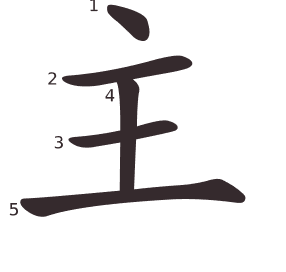
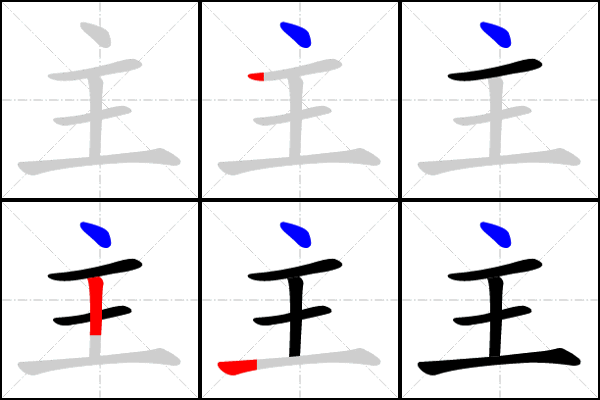 Show the animation
 Stroke data from Make Me a Hanzi, derived from the Arphic PL fonts under the Arphic Public License.
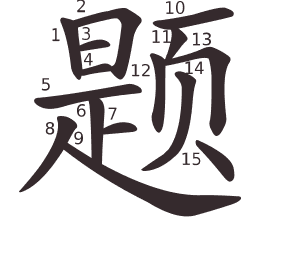
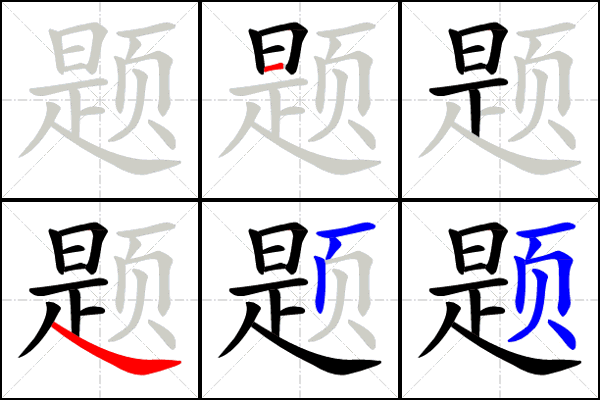 Show the animation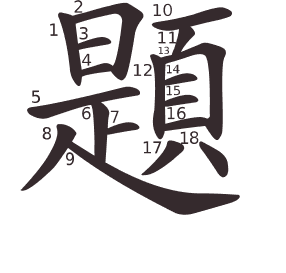
Stroke data from Make Me a Hanzi, derived from the Arphic PL fonts under the Arphic Public License.
How it used to be written
主
-
 Warring States script 戰國.秦
 -
 Clerical script 東漢
 - See all 6 forms
题
These are the forms of 題, the traditional character: 题 is a twentieth-century simplification, found in no ancient corpus.
-
 Small seal script
 -
 Clerical script 東漢
Forms, sources and dates: the 字形演變 database of 小學堂, Academia Sinica, public domain (CC0).
Examples
-
他最后一本小说的主题是什么?
What is the theme of his latest novel?
-
你觉得他会对什么主题感兴趣?
What subject do you think he is interested in?
-
演讲者不熟悉他的主题,说得又不好,总之,他很糟糕。
The speaker didn't know his subject, nor did he speak well; in short, he was disappointing.
-
这本书的主题是美国革命。
The principal theme of the book is the American Revolution.
-
高德温法则告诉我们对任何主题的所有无休止的讨论会趋于和纳粹主义的类比。
Godwin's law teaches us that any infinite discussion about an arbitrary subject converges to a Nazi comparison.