
有
Measure word
- 个 gè (classifier used before a noun that has no specific classifier); (bound form) individual attested in use
- 班 bān team; class; grade; (military) squad; work shift; CL:個|个[ge4]; classifier for groups of people and scheduled transport... attested in use
- 处 chù to reside; to live; to dwell; to be in; to be situated at; to stay; to get along with; to be in a position of; to deal... attested in use
- 家 jiā home; family; (polite) my (sister, uncle etc); classifier for families or businesses; refers to the philosophical... attested in use
- 所 suǒ actually; place; classifier for houses, small buildings, institutions etc; that which; particle introducing a relative... attested in use
- 点 diǎn point; dot; drop; speck; o'clock; point (in space or time); to draw a dot; to check on a list; to choose; to order... attested in use
Stroke order
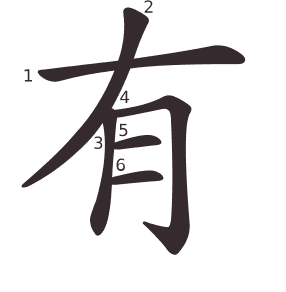
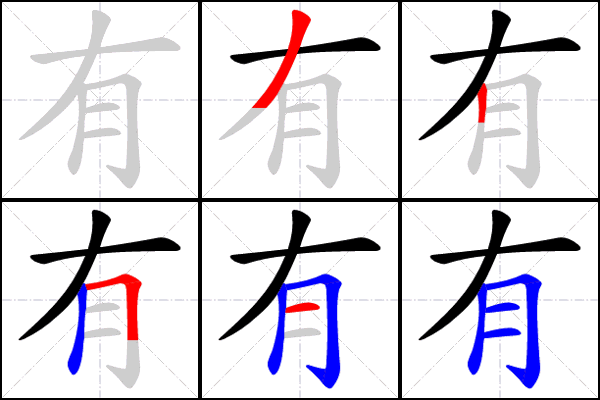 Show the animation
 Stroke data from Make Me a Hanzi, derived from the Arphic PL fonts under the Arphic Public License.
How it used to be written
-
 Oracle bone script 商
 -
 Clerical script 東漢
 - See all 13 forms
Forms, sources and dates: the 字形演變 database of 小學堂, Academia Sinica, public domain (CC0).
Examples
-
“上周你看电视了吗?”“没有,我没看。”
"Did you watch TV last week?" "No, I didn't."
-
“你有没有兄弟姐妹?” “没有,我是个独生子女。”
"Do you have any siblings?" "No, I'm an only child."
-
“坦白说,我有恐高症。”“你是个胆小鬼!”
"To tell you the truth, I am scared of heights." "You are a coward!"
-
“她有狗吗?” “没有。”
"Does she have a dog?" "No, she doesn't."
-
“没门儿!”“有。”
"No way!" "Way."
-
“这”和“那”有什么区别?
What is the difference between this and that?
-
“这看上去很有意思。”Hiroshi说道。
"This looks pretty interesting," Hiroshi says.
-
「有人放屁。」「不是我!」
"Someone farted." "It wasn't me!"