
别 別
别別 in English
- to leave / to part (from) / (literary) to differentiate / to distinguish / (dialect) to turn away / to turn aside / to avert (one's face, gaze etc) / (bound form) other / another / different / don't ...! / to fasten with a pin or clip / to stick in / to insert (in order to hinder movement) / (noun suffix) category (as in 性別|性别[xing4 bie2], 派別|派别[pai4 bie2])
- to make sb change their ways, opinions etc
Stroke order
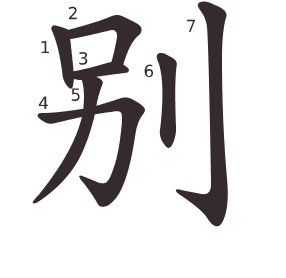
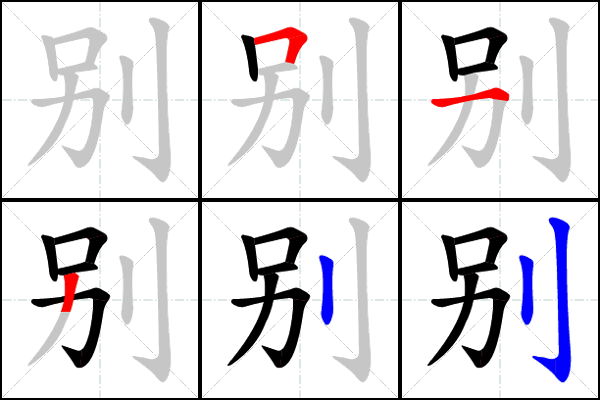 Show the animation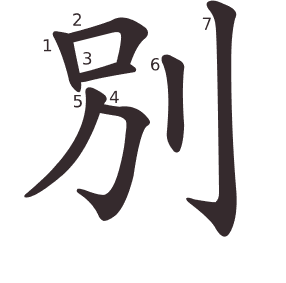
Stroke data from Make Me a Hanzi, derived from the Arphic PL fonts under the Arphic Public License.
How it used to be written
These are the forms of 別, the traditional character: 别 is a twentieth-century simplification, found in no ancient corpus.
-
 Oracle bone script 商
 -
 Clerical script 東漢
 - See all 5 forms
Forms, sources and dates: the 字形演變 database of 小學堂, Academia Sinica, public domain (CC0).
Examples
-
“这”和“那”有什么区别?
What is the difference between this and that?
-
A和B的区别是什么呢?
What is the difference between A and B?
-
万一船运迟了,我们有特别的迟到保险。
In case the shipment is delayed, we have special delay insurance.
-
不知道别的星球上有没有生物呢?
I wonder if life exists on other planets.
-
不管你做什么,别笑!
No matter what you do, don't laugh!
-
不管谁来,都别开门。
Whoever comes, don't open the door.
-
不要太过于依赖别人。
Don't depend too much on others.
-
他三番五次评判别人。
He judges other people time and again.