
么麼 in English
- suffix, used to form interrogative 什麼|什么[shen2 me5], what?, indefinite 這麼|这么[zhe4 me5] thus, etc
- youngest / most junior / tiny / one (unambiguous spoken form when spelling out numbers, esp. on telephone or in military) / one or ace on dice or dominoes / variant of 吆[yao1], to shout
Stroke order
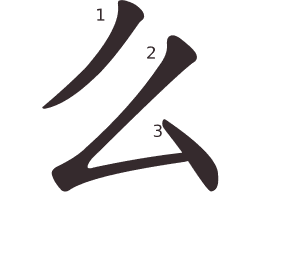
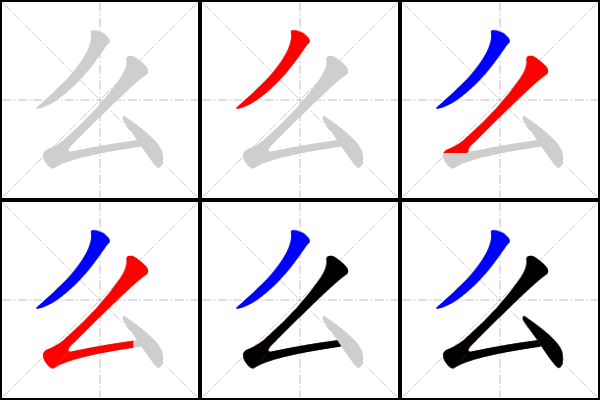 Show the animation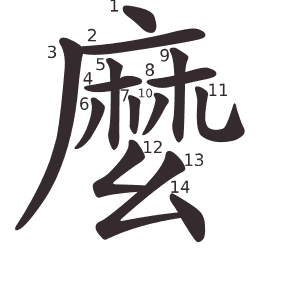
Stroke data from Make Me a Hanzi, derived from the Arphic PL fonts under the Arphic Public License.
How it used to be written
These are the forms of 麼, the traditional character: 么 is a twentieth-century simplification, found in no ancient corpus.
-
 Small seal script
Forms, sources and dates: the 字形演變 database of 小學堂, Academia Sinica, public domain (CC0).
Examples
-
我回来就解释给你听怎么用。
I'll explain to you how to use it when I come back.
-
"你为什么不去?""因为我不想去。"
"Why aren't you going?" "Because I don't want to."
-
“pretty”怎么拼写?
How do you spell "pretty"?
-
“为什么你不来?”“因为我不想。”
"Why aren't you going?" "Because I don't want to."
-
“你什么时候回来?”“这都要看天气。”
"When will you come back?" "It all depends on the weather."
-
“你对市长选举怎么看?”“我不知道。”
"What do you think of the election for mayor?" "I don't know."
-
“你怎么样?”“我很好,谢谢。”
"How are you?" "I am fine, thank you."
-
“你感觉怎么样?”他问。
"How do you feel?" he asked.