


Three Horses and Four Grooms 三駿圖
Ren Renfa 任仁發 vers les années 1320
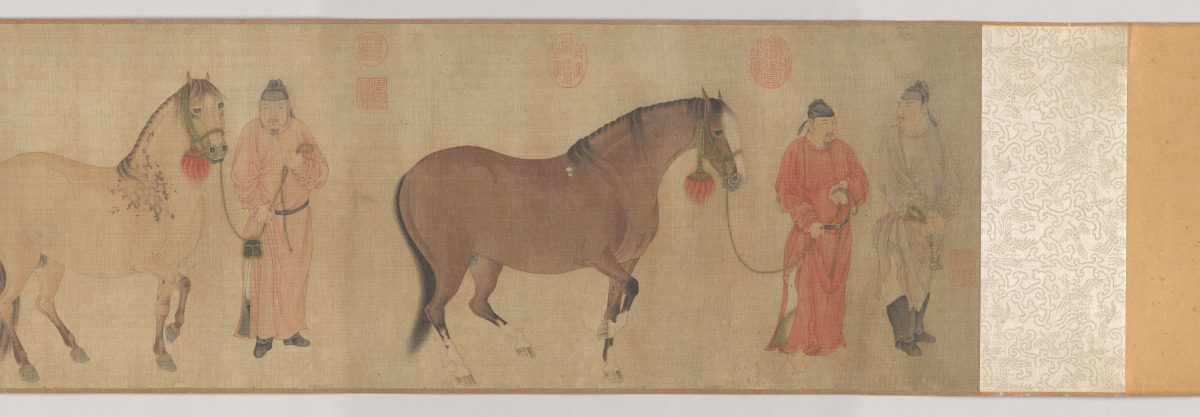
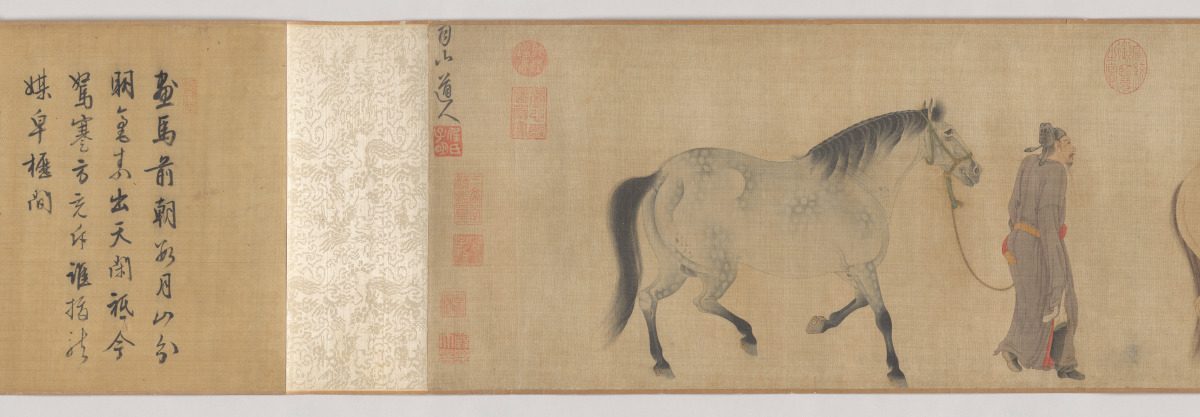
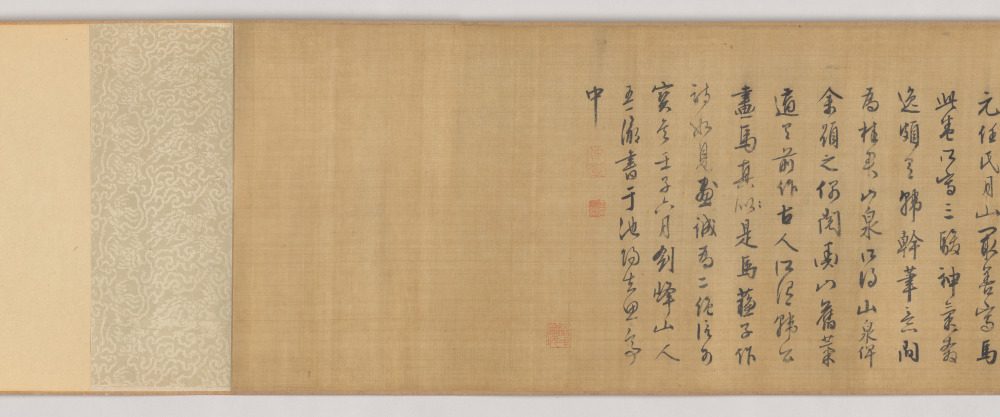
手卷 — rouleau à main. Faites défiler vers la gauche pour le dérouler, comme on le lit. 3 sections, 3400 × 417 pixels en tout.
Cette vue ne couvre qu’une partie du rouleau : les dimensions annoncées par le musée et celles de l’image ne concordent pas.
Cartel
- Artiste
- Ren Renfa
- Nom en chinois
- 任仁發
- Date
- vers les années 1320
- Période
- Chine, dynastie des Yuan (1271–1368)
- Format
- Rouleau à main (手卷), se déroule de droite à gauche
- Technique
- handscroll; ink and color on silk
- Dimensions
- Painting: 28.5 x 137.5 cm (11 1/4 x 54 1/8 in.); Overall: 29.2 x 556.4 cm (11 1/2 x 219 1/16 in.)
- Collection
- The Cleveland Museum of Art
- Numéro d’inventaire
- 1960.181
- Provenance
- Leonard C. Hanna Jr. Fund
Ce qu'en dit le musée
Ren Renfa's horse images are elegant in appearance and vigorous in spirit. His work attracted not only Chinese scholars but also the Mongols at the imperial court. Inspired by the contemporary scholarly interest in restoring a sense of antiquity in art—an artistic direction led by Zhao Mengfu that exerted a great impact in the Yuan art scene—Ren Renfa, like Zhao Mengfu, modeled his depictions of horses after the Song master Li Gonglin. Another key style component that Ren introduced to this genre was a revival of the Tang classical tradition. The refined color treatment of the horses as seen here was derived from the Tang master Han Gan.
Notice de The Cleveland Museum of Art, fiche de l'œuvre.
Le saviez-vous ?
Only the elegant first horse with a white blaze is accompanied by two grooms, as if its lightning speed required extra supervision.
The Cleveland Museum of Art
Inscriptions et sceaux
月山道人. [印] 任氏子明
Artist's signature and seal: Yue shan dao ren. [seal] Ren shi zi ming.
1 colophon and 16 additional seals: 1 poem, 1 colophon dated 1552 or 1612, and 3 seals of Wang Yiying 王一瀛 (1500s); 2 seals of Liang Qingbiao 梁清標 (1620–1691); 6 seals of the Qianlong 乾隆 Emperor (r. 1736–95); 3 seals of the Jiaqing 嘉慶 Emperor (r. 1796-1821); 1 seal of the Xuantong 宣統 Emperor (r. 1908–11); 1 seal of Yu Xiezhong 余協中 (1900s).
Poem and colophon by Wang Yiying 王一瀛 (1500s): As for painters of horses in the previous dynasty, Surely the name of Yueshan [Ren Renfa] must come first. Under his brush and on his silk, They seem to have just galloped out from the imperial stud. Now as the world overflows with inferiority, Who, from the stable, can recognize a dragon-horse amidst mediocrity. Ren Yueshan [Ren Renfa] of the Yuan Dynasty was best in horse paintings. The three fine steeds he painted in this scroll are so dashing, so vigorous in spirit that they have indeed grasped some of the "brush-idea" of Han Gan. Not long ago this painting came into the possession of Mr. Gui Shanquan, who asked for my inscription. And I, while reading the old manuscripts of Hengshan [Wen Zhengming, 1470–1559], by accident, came cross the poem quoted above. As the ancients said "in painting horses, Master Han was [inspired by and produced] real horses; in composing poems, Master Su [Su Dongpo, the leading Song poet] wrote as if a painting were before him." These are truly what should be considered the two excellences; indeed, they are to be treasured. In the sixth month of the renzi year [either 1552 or 1612]. Jian feng shan ren [The Mountain Dweller of the Sword Peak], Wang Yiying, written in the Qu si ting Pavilion at Chiyang.
Transcription et traduction : The Cleveland Museum of Art