


Fish and Rocks 魚石圖
Bada Shanren 八大山人 du milieu à la fin des années 1600
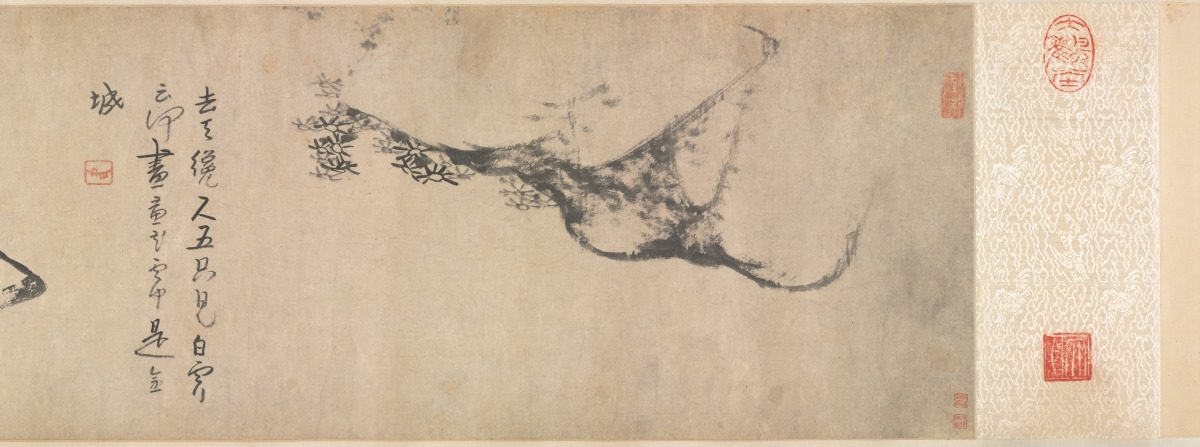
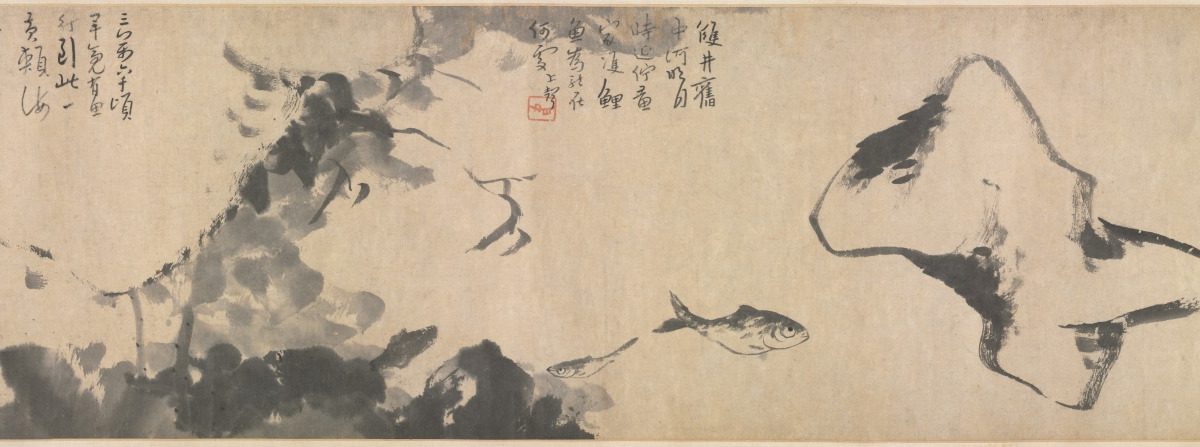
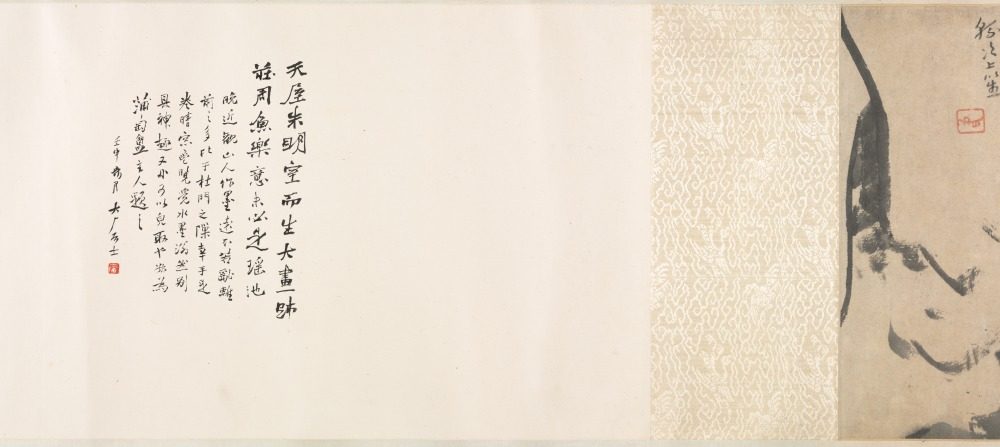
手卷 — rouleau à main. Faites défiler vers la gauche pour le dérouler, comme on le lit. 3 sections, 3400 × 447 pixels en tout.
Cette vue ne couvre qu’une partie du rouleau : les dimensions annoncées par le musée et celles de l’image ne concordent pas.
Cartel
- Artiste
- Bada Shanren
- Nom en chinois
- 八大山人
- Date
- du milieu à la fin des années 1600
- Période
- Chine, dynastie des Qing (1644–1911)
- Format
- Rouleau à main (手卷), se déroule de droite à gauche
- Technique
- Handscroll; ink on paper
- Dimensions
- Painting: 29.6 x 158.4 cm (11 5/8 x 62 3/8 in.)
- Collection
- The Cleveland Museum of Art
- Numéro d’inventaire
- 1953.247
- Provenance
- John L. Severance Fund
Ce qu'en dit le musée
Bada Shanren, also called Zhu Da, a 17th-century painter who rejected conventions in favor of an individual, personal expression, is known for his unorthodox compositions of fish, flowers, birds, and rocks. Fish in his paintings are often looking upward toward heaven, swimming in a pond of undefined space. As a member of the Ming imperial family, Zhu Da lost his princely status and hid in a monastery when the Manchus, foreigners from the north, established the Qing dynasty in 1644. This scroll may have some autobiographical meaning, representing fish as leftover subjects (yimin) who lived in a void, having lost their roles in life after the fall of the dynasty.
Notice de The Cleveland Museum of Art, fiche de l'œuvre.
Le saviez-vous ?
After each poem, Bada Shanren used his so-called jixingyin seal 屐形印, which resembles the impression of a shoe on soft mud.
The Cleveland Museum of Art
Inscriptions et sceaux
去天纔尺五,只見白雲行。 云何畫黃花,雲中是金城。 [印] 个山
Artist's inscription and 1 seal: A foot and half from heaven, One can see the floating white clouds. Why do I paint the yellow flowers? For amid the clouds is the City of Gold. [seal] Ge shan.
雙井舊中河,明月時延佇。 黃家雙鯉魚,為龍在何處。 [印] 个山
Artist's inscription and 1 seal: The Twin Wells was once in midstream. A bright moon shines in time and lingers. The twin carp in the Huang family, Where do they go to change into dragons? [seal] Ge shan.
三萬六千頃,畢竟有魚行。 到此一黃頰,海潮次上笙。 [印] 个山
Artist's inscription and 2 seals: To this 36,000 qing [of water] Here a fish is coming at last. It is but a yellowcheek. Over the ocean tides rises the sound of sheng [panpipe]. [seal] Ge shan. [seal, upper right corner] Tsai-fu.
5 additional seals: 2 of Zhang Daqian 張大千 (1899–1983); 1 of Ta-an Chü-shih; 2 unidentified.
Transcription et traduction : The Cleveland Museum of Art